
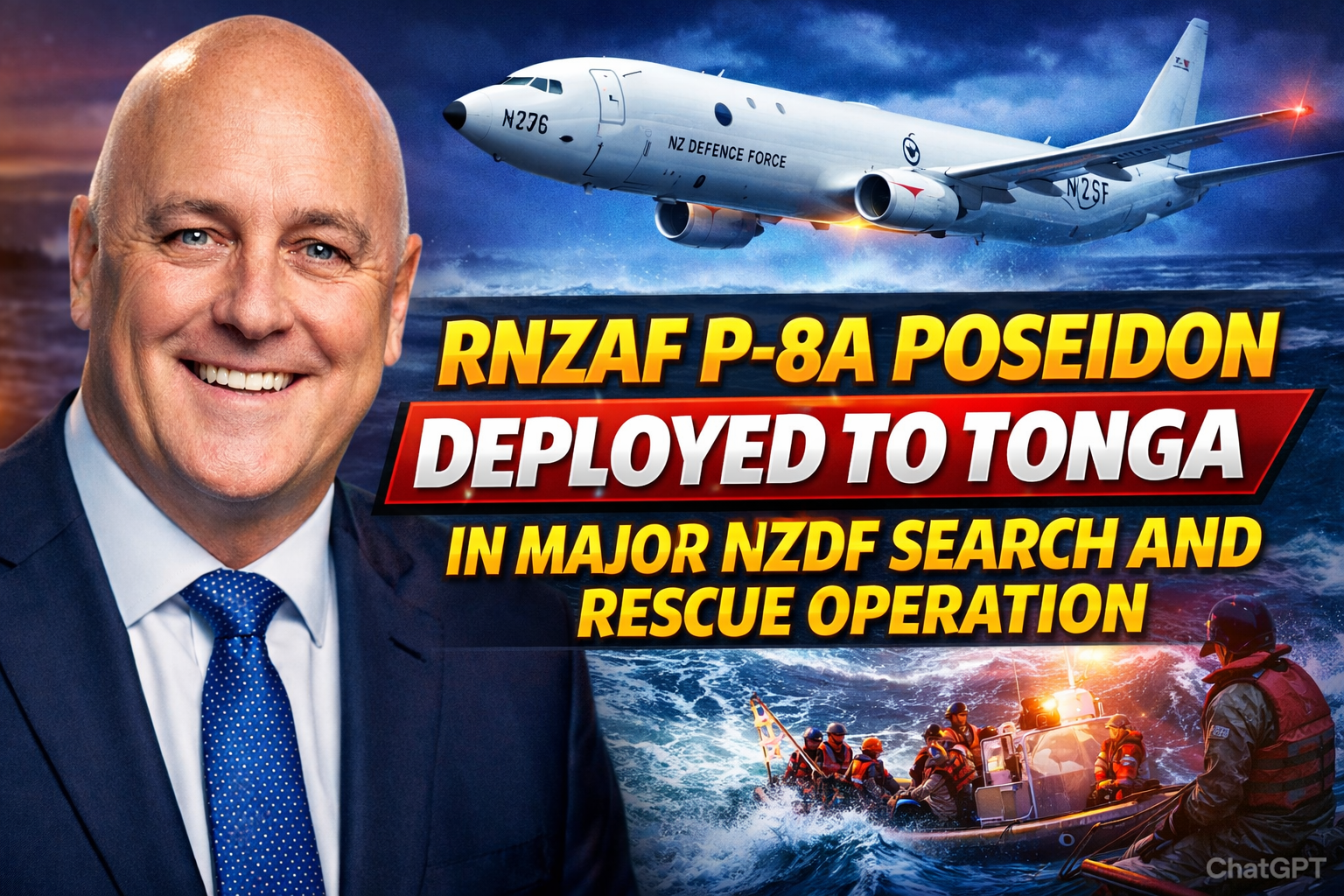
The Royal New Zealand Air Force has launched a critical P-8A Poseidon deployment to Tonga, spearheading a large-scale search and rescue mission in the South Pacific. This operation underscores New Zealand’s pivotal role in regional humanitarian efforts, blending cutting-edge maritime patrol tech with swift inter-agency coordination.
Tonga’s vast ocean expanses turned perilous when a distress signal sparked one of the largest search and rescue efforts in recent Pacific history. The RNZAF swiftly diverted its P-8A Poseidon from routine surveillance to scour the waters, marking a textbook response from the New Zealand Defence Force. This deployment highlights the aircraft’s versatility, pivoting seamlessly from fisheries patrols to life-saving missions.
Lives hang in the balance as crews endure grueling flights, scanning endless horizons for signs of distress. Tongan officials, alongside Australian and US partners, coordinate from Nuku’alofa, with New Zealand leading aerial assets. The operation tests bonds forged through years of joint exercises, proving Kiwi capability in crisis.
Public attention grips the nation, with families awaiting news and media tracking every update. Success here reinforces New Zealand’s stature as a reliable Pacific partner, ready to act when neighbours call.
Background on the P-8A Poseidon Fleet
New Zealand invested heavily in modernizing its maritime patrol wing, acquiring four Boeing P-8A Poseidons to succeed the veteran P-3K2 Orions. These jets arrived progressively from late last year, basing at Ohakea with No. 5 Squadron. Designed for endurance, each boasts a range exceeding 7,000 kilometers, perfect for Pacific expanses.
Crew training emphasized multi-role flexibility—anti-submarine warfare one day, disaster relief the next. Integration with allies’ systems ensures seamless data flow during joint ops. The fleet’s arrival elevated NZDF’s projection, covering exclusive economic zones and beyond.
This Tonga mission represents early high-stakes validation, showcasing taxpayer dollars at work in real-time salvation efforts.
Incident Details and Initial Response
A pleasure yacht vanished en route from Fiji, carrying adventurers whose last radio contact pinpointed Tongan seas. Rough weather likely played a role, with cyclones brewing nearby. Tongan Maritime Police issued the alert, prompting NZDF activation within hours.
Joint Rescue Coordination Centre in Wellington orchestrated the launch, redirecting the nearest P-8A mid-flight. Ground teams prepped fuel relays via Whenuapai, while diplomats liaised for overflight clearances. Speed proved crucial—golden hours for survival ticked away.
Initial sweeps focused debris fields, leveraging satellite imagery to narrow grids. This proactive stance minimized delays, embodying NZDF’s “ready to respond” ethos.
Mission Execution in Tonga Waters
The Poseidon thundered over Tongatapu, unleashing side-looking radar to pierce cloud cover. Crews dropped sonobuoys, listening for emergency beacons or hull pings, while infrared cameras hunted heat signatures at dusk. Grid patterns overlapped for redundancy, covering swaths no helicopter could match.
Tonga’s reefs and atolls complicated visuals, demanding precision altimetry. Captains adjusted for swells, dipping low for visual confirms. Real-time feeds beamed to command centers, enabling dynamic shifts.
Endurance shone—refueling probes extended loiter times, outlasting daylight constraints.
Stats and Operation Highlights Table
Numbers tell the tale of intensity, from vast coverage to tech deployments. These metrics affirm P-8A’s superiority over predecessors, handling adverse conditions without falter.
NZDF’s Regional Commitment
New Zealand has long punched above weight in Pacific security, from Cyclone Harold aid to fisheries enforcement. Tonga deployments build on HADR exercises like Croix du Sud, fostering trust. Shared threats—illegal fishing, disasters—glue partnerships.
This op amplifies soft power, with Kiwi crews training locals post-mission. It’s diplomacy in action, extending Wellington’s reach without fanfare.
Technological Edge of P-8A
Multi-mode radar detects flotsam amid waves; electro-optical turrets zoom on anomalies. Synthetic aperture modes map wreckage precisely. Sonobuoys form underwater nets, pinging for submerged risks.
Linkage to MQ-4C drones or allied P-3s multiplies eyes. Secure datalinks feed rescuers instantly, slashing response lags. Upgrades ensure relevance for decades.
Challenges and On-Ground Coordination
Remote Tonga strained logistics—Fua’amotu runway handled heavies, but spares shipped afar. Monsoon rains slicked runways, testing pilots. Crews rotated via C-130 shuttles, combating fatigue.
Nuku’alofa hubs buzzed with briefings; translators bridged gaps. Cultural nods—sharing kava—eased tensions, turning ops into collaborations.
Outcomes and Discoveries So Far
Patrols spotted life rafts and debris, narrowing pools. A false alarm on whale spouts honed protocols. Leads point southward, with sub-surface searches ramping.
Rescue swimmers stand ready; hopes persist as assets converge. Every hour yields clues, sustaining momentum.
Broader Implications for NZDF
Triumph here bolsters budgets, silencing critics. Allies note reliability, opening doors for tech shares. Climate-vulnerable Pacific demands such readiness—NZDF steps up.
Lessons refine doctrines, from AI aids to greener fuels.
Human Stories from the Mission
Aboard, navigators share tales of dawn sightings; families beam with pride. In Tonga, villages pray at fale churches, hosting Kiwi crews. Missing kin fuel resolve—personal stakes drive excellence.
Future Preparedness
Debriefs sharpen edges; sims replay scenarios. Fleet surges eyed for growing threats. Poseidon cements NZDF as Pacific guardian.

Lance Evans is a contributor at CSKHYBER.co.nz covering New Zealand and Australia news, with a focus on trending updates and public-interest stories.