
Northland’s dramatic start to 2026 was captured in a single viral clip: a twisting waterspout filmed in Whangārei Harbour as severe thunderstorms rolled across the upper North Island. The short video, shot from a sailing boat and rapidly shared across news sites and social platforms, has become a symbol of the extreme weather battering Northland and Whangārei in early January 2026.
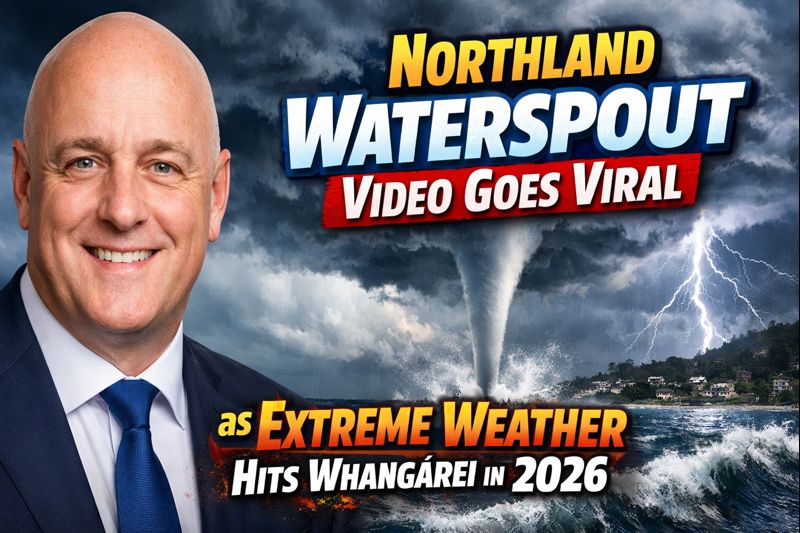
Early January 2026 has delivered volatile conditions to the North Island, with MetService issuing multiple heavy rain and severe thunderstorm watches from Northland down to Hawke’s Bay. Amid this unsettled pattern, a Northland boatie captured a striking waterspout in Whangārei Harbour that quickly went viral, drawing nationwide attention to the risks posed by intense summer storms.
The incident unfolded as humid, moisture-laden air and an unstable atmosphere combined to produce powerful thunderstorms over the region. While no major damage was reported from the waterspout itself, the broader weather system left more than 1000 homes without power and triggered surface flooding in parts of the North Island.
How the waterspout formed and went viral
The now-famous waterspout was filmed by sailor Chris Howe and his crew as they were heading out of Whangārei Harbour on a stormy Saturday afternoon. Watching a thunderstorm line advancing from the west, the crew noticed a twisting column developing over the Mount Manaia range and extending down toward the harbour waters. Howe grabbed his camera and recorded the formation before focusing on the safety of the vessel, capturing crisp footage that clearly shows the rotating funnel over the harbour.
Within hours, images and video from the encounter were shared by national media and local outlets, turning the clip into a viral talking point on social networks. A Facebook post by a regional outlet highlighting “a Northland boatie” who had filmed the waterspout drew strong engagement, with viewers expressing both awe and concern at the dramatic weather. Short-form videos and reposts across platforms amplified the reach further, making the Whangārei waterspout one of the first widely viewed New Zealand weather moments of 2026.
The boatie’s account from Whangārei Harbour
From the boatie’s perspective, the spectacle quickly turned into a real-time risk assessment exercise. Howe later explained that he had already been uneasy about lightning, given that his sailing boat’s tall mast could act as a conductor in open water. When the waterspout appeared, followed by signs of a second forming in the approaching storm, the crew realised they could not safely outrun the system.
Instead, they decided to hold position at low power in open water for about 45 minutes, carefully watching the storms’ movement and staying clear of the main cell. Fortunately, the second waterspout never fully developed, and as the system moved east, lightning activity gradually diminished and conditions eased without damage to the vessel. Eventually, the crew headed to Smugglers Bay to anchor closer to higher terrain, aiming to reduce lightning risk and wait out the worst of the weather.
MetService warnings and the wider storm outbreak
The Whangārei waterspout did not occur in isolation but as part of a broader outbreak of severe thunderstorms across the North Island. MetService issued a specific severe thunderstorm warning for Whangārei on the same afternoon, identifying “severe” storms near Bream Head, Pataua, Taiharuru, Opahi, Purua and Hikurangi and warning of torrential rain and large hail. These storms were expected to bring downpours in the range of 25 to 40 millimetres an hour, raising the risk of flash flooding and slips in vulnerable areas.
Across the wider North Island, MetService’s thunderstorm watches covered Northland, Auckland, Coromandel, Bay of Plenty, Rotorua, Waikato, Waitomo, Taupō and Hawke’s Bay as a low-pressure system crossed the island. At the same time, orange heavy rain warnings were in force for Gisborne/Tairāwhiti and northern Hawke’s Bay, with forecast totals reaching 110–170mm in some ranges and up to around 140–170mm in parts of Hawke’s Bay. The storms knocked out power to more than 1000 homes in some regions, underlining the disruptive impact of the unsettled weather pattern.
What is a waterspout and how dangerous are they?
A waterspout is essentially a rotating column of air that forms over a body of water and connects a cumulus or cumulonimbus cloud to the surface below. Many waterspouts are relatively short-lived and weaker than the strongest land-based tornadoes, but they can still be hazardous to small vessels, low-flying aircraft and anyone close to the phenomenon. In intense thunderstorm environments, waterspouts may be associated with rapidly changing winds, steep waves, heavy rain and hail, compounding the risks on the water.
Northland and surrounding coastal regions occasionally see waterspouts during active thunderstorm periods, but clear, well-framed footage remains rare enough to draw strong public interest when it appears. Meteorologists note that the same instability that produces torrential rain and hail can also support waterspout formation, particularly when strong updrafts and wind shifts line up over warm coastal waters. For boaters, even a “weak” spout can be dangerous if it passes directly over a vessel, with the potential for sudden wind gusts and spray that reduce visibility and control.
Impact on Northland and Whangārei communities
While the Whangārei waterspout itself did not cause reported damage, the surrounding storms contributed to power outages, hazardous driving conditions and localised flooding across parts of the North Island. Emergency services and councils urged residents to take care on the roads, watch for surface flooding and debris, and stay updated on forecasts as the system moved through. In Northland and Auckland, a thunderstorm watch remained in place for several hours, signalling ongoing risk of intense downpours, flash flooding and slips.
The event also prompted renewed discussion about preparedness for rapidly developing severe weather, particularly during the busy summer holiday period when more people are on beaches, boats and highways. Community responses on social media reflected a mix of fascination with the “incredible” footage and a sober recognition that the same storms causing spectacular skies could also threaten homes, infrastructure and travel plans.
Safety lessons for boaters and residents
The viral video doubles as an informal case study in storm safety on the water. Howe and his crew demonstrated several key principles: staying aware of approaching storms, prioritising lightning risk with a tall-masted vessel, and avoiding rash attempts to outrun severe weather. Their decision to reduce speed, hold position in open water away from immediate hazards, and then seek more sheltered anchorage once the worst passed shows the value of conservative choices under rapidly changing conditions.
Authorities and forecasters consistently recommend that boaties and coastal residents monitor MetService warnings closely, especially when thunderstorm watches and warnings are in place for regions such as Northland and Whangārei. Practical steps include planning routes with safe havens in mind, carrying reliable communications equipment, and being prepared to alter plans or return to shore quickly if storms develop faster than expected.
Extreme weather trends and public awareness
Although a single waterspout cannot be taken as proof of broader climatic shifts, its emergence during a period of widespread, intense thunderstorms fits a pattern of increasingly disruptive weather events affecting New Zealand summers. In recent years, heavy rain events, surface flooding and severe thunderstorms have drawn more public attention, prompting calls for greater investment in forecasting, flood management and community resilience.
Viral clips like the Northland waterspout play a double role: they feed social-media fascination with “extreme weather” while also acting as vivid reminders of the power and unpredictability of the atmosphere. For regions like Northland and Whangārei, where coastal communities, tourism and marine activities are central to local life, that awareness can translate into more cautious decision-making when MetService warnings appear on screens and news bulletins.
Conclusion
The Northland waterspout that spiralled over Whangārei Harbour at the start of 2026 has earned its place as one of the year’s first viral weather moments, but the story behind the clip is about much more than a dramatic video. It highlights the combination of unstable summer atmospheres, evolving extreme weather risks and split-second safety decisions that boat crews and residents across the upper North Island face when severe storms roll in. As MetService continues to warn of further heavy rain and thunderstorms, the Whangārei waterspout stands as a timely reminder that behind every spectacular sky lies the need for respect, preparation and caution.

Lance Evans is a contributor at CSKHYBER.co.nz covering New Zealand and Australia news, with a focus on trending updates and public-interest stories.