
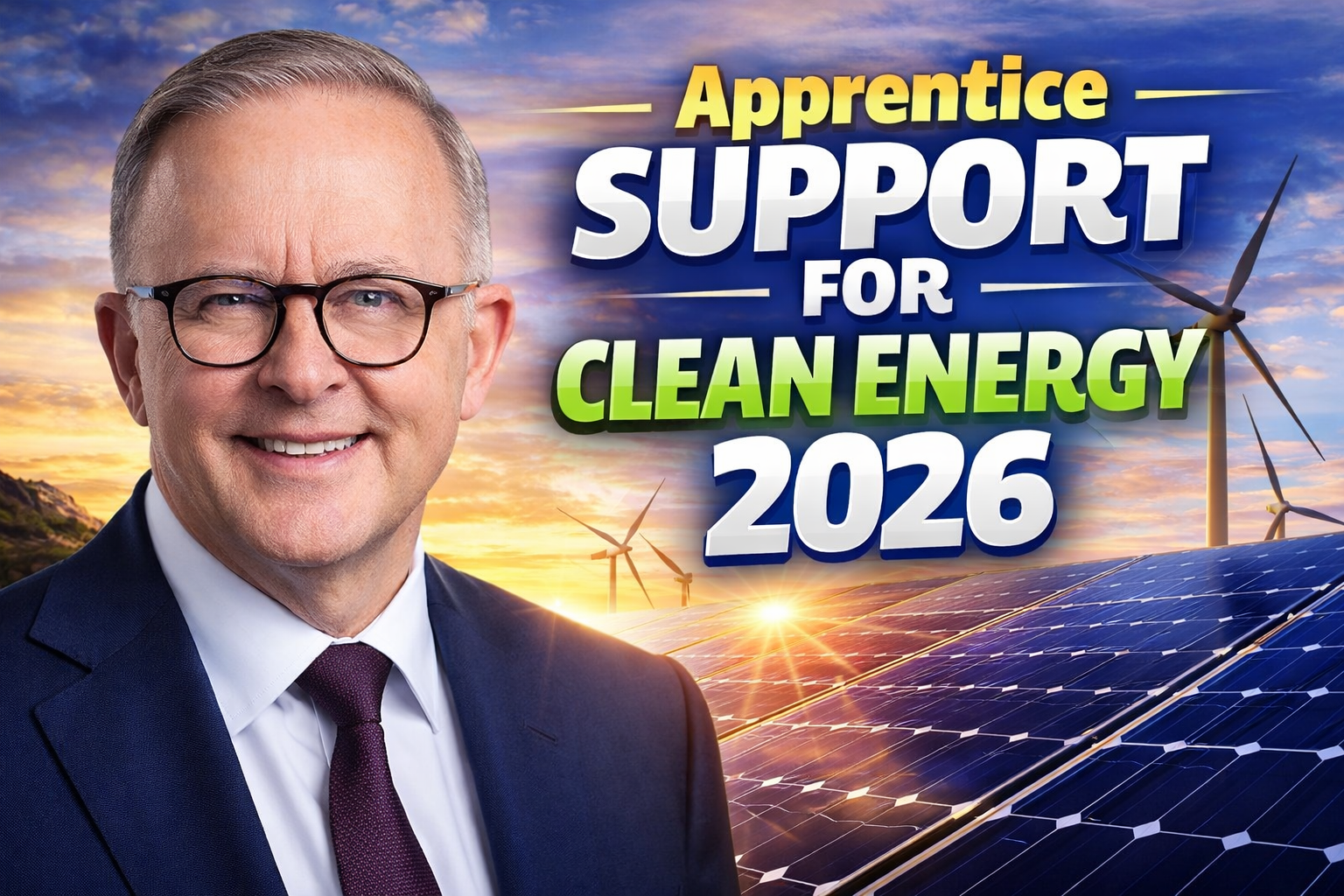
Australia’s push toward net-zero emissions accelerates with expanded apprenticeship incentives targeting clean energy sectors in 2026. The Key Apprenticeship Program offers up to 10,000 dollars for trainees and 5,000 dollars for employers, building on the New Energy Apprenticeships initiative to skill up thousands. These measures address workforce shortages in renewables, boosting job prospects for young Australians entering booming fields like solar installation and battery systems.
Overview of the Key Apprenticeship Program
Launched mid-2025 as an evolution of the New Energy Apprenticeships Program, the Key Apprenticeship Program prioritizes clean energy alongside housing construction. Extended through December 2026, it delivers targeted financial aid to encourage commencements and completions in high-demand trades. Over 15,000 new energy apprentices started since July 2025, with 6,600 in housing streams, demonstrating strong uptake.
Administered via Australian Apprenticeship Support Network providers, payments disburse progressively over training. Trainees receive direct support easing living costs, while employers gain hiring incentives offsetting wages and mentoring. This dual approach aligns with Future Made in Australia plans for net-zero and 1.2 million homes by 2029.
Eligibility for Trainees
Qualify as an Australian Apprentice commencing or recommencing from July 1, 2025, in a Certificate III, IV, Diploma, or Advanced Diploma on the Priority List flagged as clean energy. Occupations span electricians, refrigeration mechanics, and metal fabricators working in renewables. Full-time trainees access 10,000 dollars total, part-time half at 5,000 dollars.
Employers must operate in clean energy, providing substantial on-job exposure like solar panel installs or wind turbine maintenance. Age, residency, and training contract standards apply universally. Existing apprentices transitioning to clean energy pathways remain eligible if meeting priority criteria.
Exclusions bar those receiving overlapping supports like standard apprentice payments. Women, Indigenous trainees, and regional starters often access extras via diversity streams.
Financial Incentives Breakdown
Trainees pocket up to 10,000 dollars disbursed in installments tied to milestones: 2,000 dollars yearly for full-timers, scaling with progress. Funds cover tools, travel, or accommodation, paid quarterly post-RTO sign-off. Part-timers halve amounts proportionally.
Employers claim 5,000 dollars in two lumps: half at six months, half at twelve, recognizing retention efforts. Key sectors retain full prior levels, unlike non-priority trades dropping to 2,500 dollars each side.
| Incentive Type | Trainee Amount (Full-Time) | Employer Amount | Payment Schedule |
|---|---|---|---|
| New Energy Stream | Up to 10,000 dollars | 5,000 dollars | Quarterly for trainees; 6/12 months for employers |
| Housing Construction (Companion) | Up to 10,000 dollars | 5,000 dollars | Same as above |
| Non-KAP Priority | 2,500 dollars | 2,500 dollars | Reduced from Jan 2026 |
Interest-free loans up to 25,000 dollars supplement for tools, repayable above 67,000 dollars income threshold.
Targeted Clean Energy Occupations
Priority List highlights 40-plus roles: electricians specializing in EV charging, solar/hot water installers, wind turbine technicians, battery storage fitters. Refrigeration for heat pumps, sheetmetal workers fabricating panels, and boilermakers for turbine components qualify with clean energy employer focus.
Qualifications like CPC30620 Certificate III in Scaffolding support offshore wind farms. Electronics trades adapt to smart grids. Employers prove sector engagement via contracts or operations in solar farms, hydrogen plants.
| Sample Clean Energy Occupations | Qualification Level | Example Roles |
|---|---|---|
| Electrician (General/Solar) | Cert III | PV systems, inverters |
| Refrigeration & Air Conditioning | Cert III/IV | Heat pumps, efficiency retrofits |
| Metal Fabricator | Cert III | Wind tower components |
| Fitter (Mechanical) | Cert III | Battery assembly |
| Electronics Trades Worker | Cert III | Grid controllers |
How to Apply and Get Started
Contact local Apprenticeship Network provider like BUSY at Work or MEGT for free matching. Submit resume, select clean energy employer via job boards or Skills Insight portals. Sign training contract, nominate RTO for off-job delivery.
Employers declare clean energy operations during signup, verified via ABN checks. Trainees track via myGov for payments. Commence by December 2026 to lock extended rates.
Steps:
- Research occupations on apprenticeships.gov.au Priority List.
- Connect with providers for employer intros.
- Complete pre-apprenticeship if needed (funded).
- Sign contract, commence training.
Benefits for Trainees and Employers
Trainees gain stable income around Award minimums—60,000 dollars year one rising—plus incentives covering PPE or relocation. Hands-on experience in growing sector promises 80,000 jobs by 2030. Completion rates improve with financial buffers.
Employers offset 20-30 percent first-year costs, access wage subsidies, and build loyal teams for projects like Snowy 2.0 expansions. Tax deductions on training amplify returns.
Programs like Powering Women into Clean Energy target diversity, offering mentoring.
Broader Impact on Australia’s Clean Energy Transition
Incentives fuel 1.2 million home builds and renewable targets: 82 percent clean power by 2030. Sun Cable and hydrogen hubs demand skilled labor; apprentices fill gaps left by retiring trades.
Regional Victoria’s wind farms, Queensland solar mega-projects thrive. Indigenous employment via Remote Australia pathways integrates cultural training.
Economic multipliers: each apprentice generates 2.5 jobs indirectly via supply chains.
Challenges and Considerations
Employer proof of clean energy focus deters some; audits ensure compliance. Part-time flexibility suits mature-age starters, but full-time maximizes aid. Retention hinges on quality mentoring—providers offer resources.
Competition heats for spots; early applications key. Wage pressures in renewables demand negotiation.
| Challenges | Mitigation Strategies |
|---|---|
| Employer verification | Provider audits, sector declarations |
| Regional access | Relocation grants, online training |
| Completion drop-off | Milestone payments, mentoring |
| Skill mismatches | Pre-apprenticeship bridging |
Future Outlook Beyond 2026
Post-2026, incentives evolve with net-zero progress; evaluations shape permanence. Hydrogen electrolyser fabricators, green steel roles emerge. Integration with TAFE Australia funds free Cert IV upskilling.
Industry forecasts 500,000 clean jobs by 2050; apprentices lead. Government eyes micro-credentials for rapid reskilling.
Success Stories and Case Studies
Electrician apprentice in Hunter Valley transitioned via KAP to solar farm role, banking 8,000 dollars aid. Female refrigeration mechanic in Brisbane retrofits heat pumps, crediting incentives for family support.
Employer panels: Solar firm hired 20 via program, halving turnover.
Getting Involved Today
Providers host info sessions; job sites like Seek list sponsored spots. Schools integrate via VET in Schools clean energy modules. Trainees: build basics via free TAFE tasters.
Australia’s clean energy boom awaits—2026 incentives pave entry to sustainable careers rewarding skills, stability, and impact.

Lance Evans is a contributor at CSKHYBER.co.nz covering New Zealand and Australia news, with a focus on trending updates and public-interest stories.