
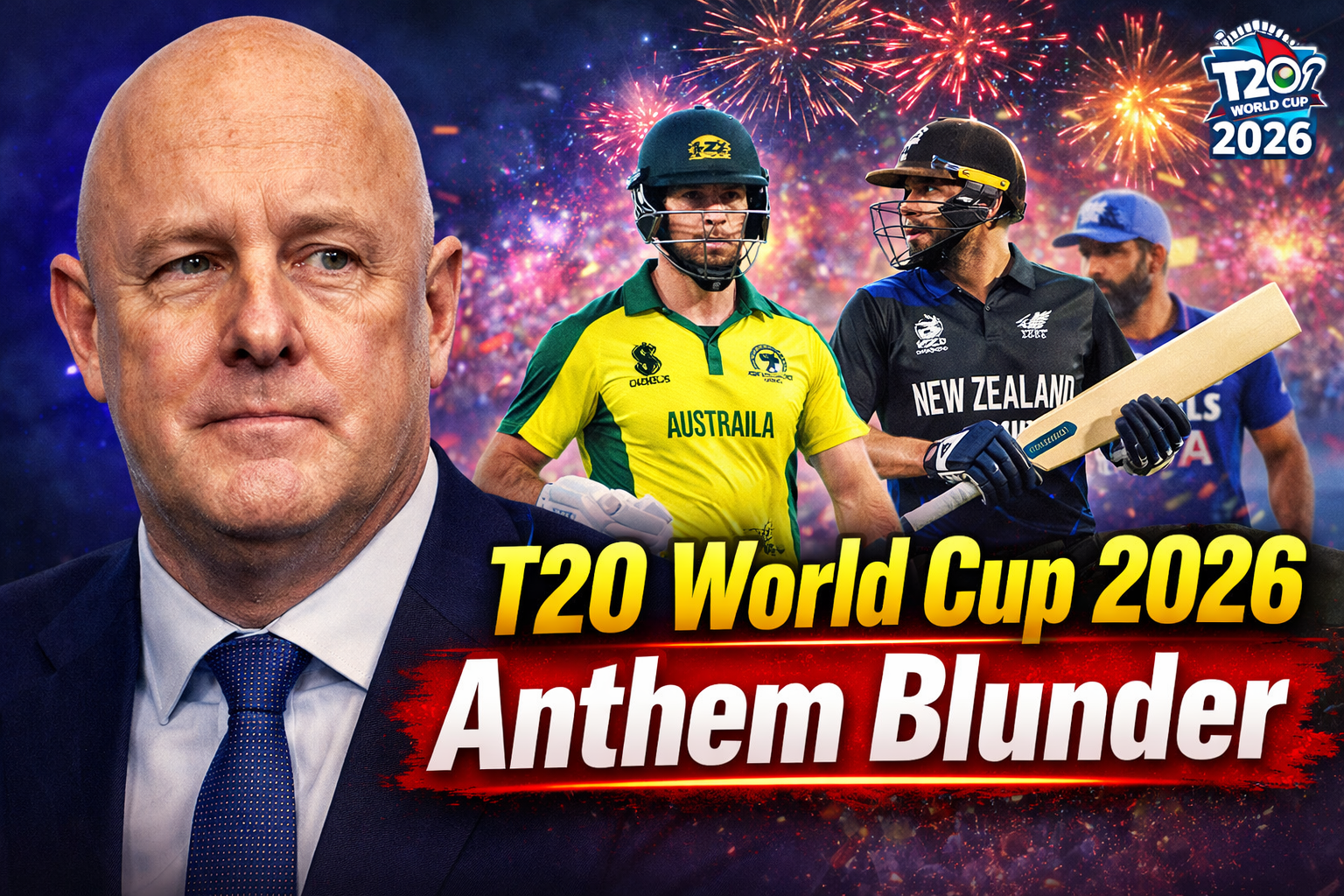
A moment that was supposed to be solemn turned into a viral comedy reel as the T20 World Cup 2026 hit its first major off‑field controversy: a wrong‑speed version of New Zealand’s national anthem, “God Defend New Zealand,” blared through the stadium ahead of a crucial Super Eight clash against England in Colombo. The technical glitch, played out in front of a packed Premadasa Stadium and a global audience, left players, fans, and broadcasters alike stunned, amused, and questioning how something so fundamental could go so wrong in a marquee ICC event.
The Setup Before the England–New Zealand Clash
The match itself was charged with meaning. Sitting in the Super Eight stage, New Zealand’s campaign hinged on a win to keep semifinal hopes alive, while England, already on the brink of qualification, treated the game as a chance to solidify their position at the top of the group. The traditional pre‑match pageantry—team entrances, national anthems, and the ceremonial coin toss—was expected to underline the occasion’s importance. Instead, the opening act became less about nationalism and more about audio engineering.
As the Black Caps assembled on the field, players linked arms and readied themselves for the anthem. The crowd fell into a respectful hush, cameras zeroed in on the squad, and the moments before first‑ball tension normally peak. That is when the botched anthem began.
What Actually Went Wrong
The production team did not play a different country’s song; they played New Zealand’s own anthem, just in an unnaturally fast tempo. The track came out sounding like a sped‑up, cartoonish version of “God Defend New Zealand,” almost as if someone had accidentally hit the “fast forward” button on an audio file. The melody was recognisable, but the rhythm was distorted, making any attempt to sing along or stay in step nearly impossible.
On camera, the effect was instant and visible. New Zealand players tried to keep their composure, some mouthing lyrics as the anthem skittered past, while others simply stared at the speakers, wide‑eyed. Soon, stifled smirks turned into open laughter. Finn Allen was seen barely able to keep a straight face, Tim Seifert chuckled quietly, and pace‑bowler Matt Henry was captured laughing outright. The coaching staff did not fare much better, with several members caught on broadcast feeds shaking their heads in disbelief.
Across the boundary rope, English players and staff could also be seen grinning, caught in the awkward, shared amusement of witnessing a live‑broadcast glitch of this magnitude. The moment quickly spilled onto social media, with clips of the sped‑up anthem and the players’ reactions spreading across platforms in minutes.
Why Anthems Matter in Cricket
In modern international cricket, the minutes before the toss are more than protocol; they are ritual. The national anthem is one of the few moments when sport, identity, and emotion converge in a single, uninterrupted sequence. For many players, it is a quiet mental reset—standing shoulder‑to‑shoulder in their team colours, remembering what they are representing beyond the scoreboard. For fans, the anthem is a cue to connect with national pride, to feel the collective weight of the contest ahead.
When that moment is distorted—by the wrong song, the wrong speed, or a technical fault—the symbolism breaks down. What should have been a dignified, unifying experience turned into a slapstick interlude. For some, the blunder trivialised the occasion; for others, especially older fans, it felt like a minor indignity to the team and the country. Yet, the players themselves seemed to take it with trademark Kiwi humour, treating it as a light‑hearted hiccup in an otherwise high‑pressure environment.
The Reaction From Players and Fans
The on‑field reaction was telling. After the distorted anthem concluded and the usual formalities resumed, several Black Caps were seen nudging each other, still chuckling quietly as they took their positions. The atmosphere in the dressing room, both immediately before and after the match, appeared to be more relaxed than usual, almost as if the mishap had inadvertently eased pre‑game nerves.
In the post‑match interviews, New Zealand captain Mitchell Santner acknowledged the incident with a wry smile, describing it as “one for the family videos” and suggesting that the team used the absurdity to diffuse tension. Commentators meanwhile oscillated between amusement and mild criticism, with some pointing out that the ICC’s technical teams ought to have a failsafe protocol for such basic ceremonies, especially in a World Cup.
Social media erupted with memes and short clips. Fans in India, the UK, and New Zealand alike shared screenshots of the players’ reactions, overlaying captions such as “Even the anthem is spinning faster than the leg‑spinners” or “When the DJ hits the turbo button on the Black Caps.” The incident became a talking point that, for many, overshadowed the pre‑match analysis.
How Match Officials and Broadcast Handled the Blunder
From the officials’ perspective, the incident was a systems‑level embarrassment. The ground’s audio team, the ICC’s broadcast operations, and the local technical crew all share responsibility for ensuring that the anthem sequence runs smoothly. In a tournament as high‑profile as the T20 World Cup, there is usually a checklist for pre‑match tasks, including audio cue‑ups, language verification, and timing. Yet, in this case, someone either loaded the wrong file or failed to normalise the playback speed.
After the incident, the on‑field broadcast cut away quickly to B‑roll footage and replays, as if the producers were trying to minimise the duration of the gaffe. Later, the ICC and local organisers issued a brief statement acknowledging the technical error, calling it an unfortunate mistake and confirming that reviews were underway to ensure similar issues did not recur in other fixtures.
The silver lining, at least from a broadcast‑design standpoint, was that the error did not disrupt the actual match. The players adapted, the technical team moved on, and the game itself unfolded as a tightly fought contest, with New Zealand posting a competitive total and England hunting it down in a tense chase.
The Bigger Picture: Professionalism in Global Events
While the anthem blunder was not a match‑altering incident, it touched a raw nerve about how meticulously big‑ticket global events are supposed to be managed. The T20 World Cup 2026 is marketed as a showcase of the game’s cutting‑edge production, with 360‑degree cameras, real‑time analytics, and high‑definition broadcast packages. That such a basic element as the national anthem could be mishandled raises questions about quality control and oversight.
Critics pointed out that in other major sporting events, anthems are tested well in advance, sometimes in multiple languages, and double‑checked by both local and international teams. Some commentators suggested that the ICC needed to standardise anthem protocols across all host cities, perhaps even centralising the audio files with speed and format checks built into the workflow. Others argued that local organisers should be held accountable for ensuring that every ceremonial detail meets a minimum standard, especially when the host nation is putting its own administrative and technical capabilities on display.
The Human Side of the Incident
On a human level, the botched anthem also highlighted how intangible moments can shape the mood of a contest. For visiting teams, particularly in high‑pressure knockout‑style stages, tension can be overwhelming. The expectation to be composed, focused, and ready for battle is immense. When something as unexpected and slightly absurd as a sped‑up anthem interrupts that mental state, it can either spike anxiety or act as a pressure valve.
In this case, the New Zealand players leaned into the second option. The laughter was not a sign of disrespect, but an instinctive release of energy. It reminded viewers that, beneath the professional exteriors and the sponsors’ branding, cricketers are still people who can find humour even in the middle of a high‑stakes environment.
The Match Outcome Amid the Misstep
The on‑field contest, once the ceremony was over, unfolded into a classic T20 World Cup thriller. New Zealand won the toss and chose to bat first, looking to build a platform that would keep their semifinal hopes alive. Openers Finn Allen and Tim Seifert provided an early spark, while Glenn Phillips and Mark Chapman steadied the innings after a mini‑collapse. Captain Mitchell Santner finished with a six off the final ball, taking the total to a competitive 159‑for‑7.
England, in pursuit, lost Phil Salt early and saw Jos Buttler struggle again, but key partnerships between the middle and late order guided them through. The visitors eventually crossed the line with a few balls to spare, sealing a four‑wicket victory that kept them at the top of the Super Eight group. For New Zealand, the result was a setback, but not a complete end—qualification remained alive, albeit dependent on the outcomes of other fixtures.
Why the Anthem Gaffe Will Be Remembered
In the broader narrative of the T20 World Cup 2026, the anthem blunder is unlikely to be the defining moment of the tournament. There will be more dramatic finishes, more spectacular sixes, and more intense rivalries. Yet, this particular incident will linger in the collective memory because it caught everyone off guard at a moment that is usually predictable and controlled.
It will be remembered as the match where the anthem sounded like it was being played on fast‑forward, where players could not hold back their laughter, and where professionalism briefly collided with human error. For New Zealand fans, it will be a bittersweet memory—part comic relief, part reminder that even in the grandest spectacle, small details can slip. And for the organisers, it will stand as a case study in why no element of the show, not even the few minutes before the toss, should ever be treated as routine.

Lance Evans is a contributor at CSKHYBER.co.nz covering New Zealand and Australia news, with a focus on trending updates and public-interest stories.