
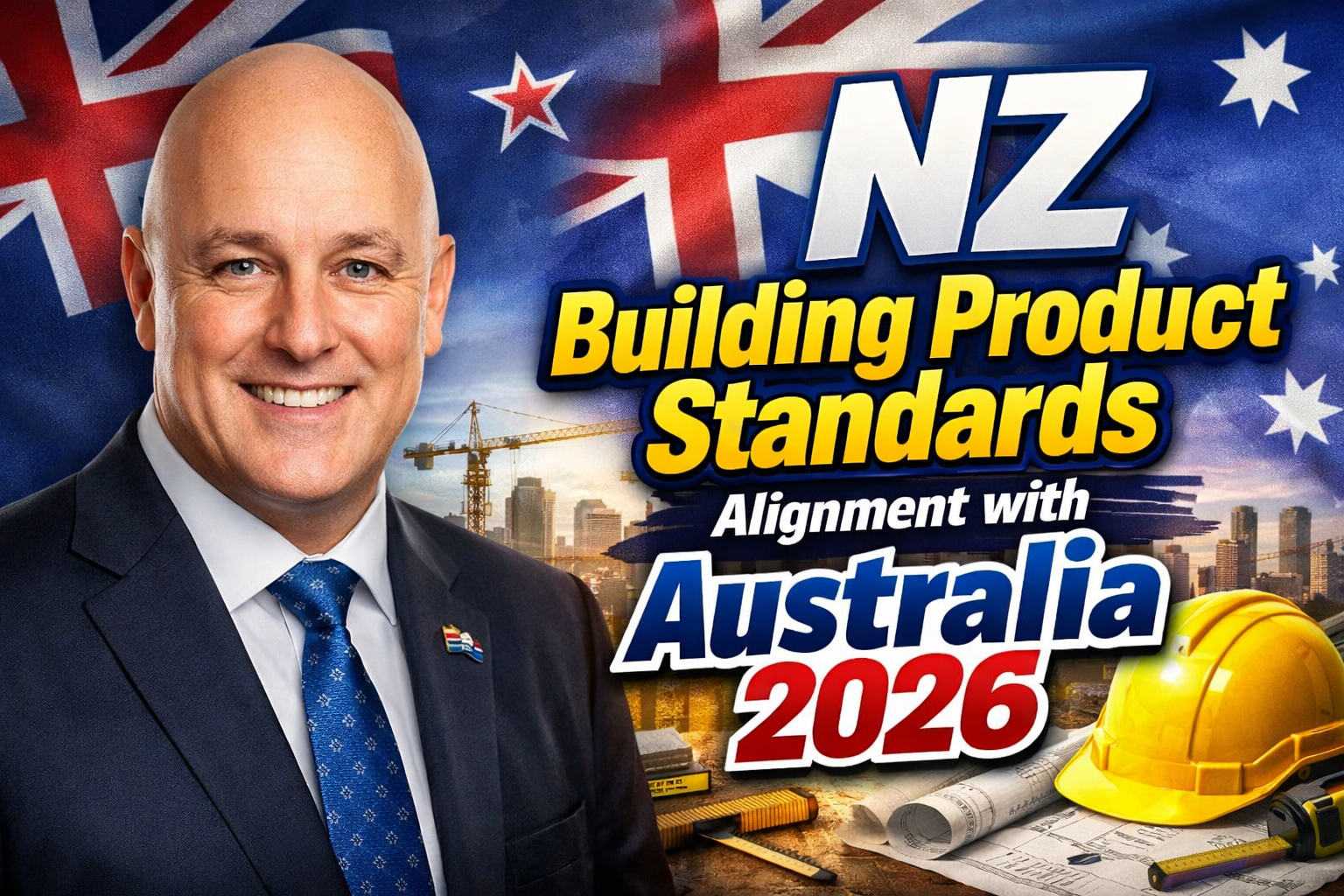
New Zealand’s building product standards are aligning more closely with Australia’s in 2026 through targeted reforms and a fresh trans-Tasman agreement. This shift promises smoother trade, reduced red tape, and greater choice for constructors facing supply strains.
Background on Standards Alignment
New Zealand and Australia have long pursued a seamless Single Economic Market under Closer Economic Relations. Building standards lagged due to distinct codes—NZ’s Building Code versus Australia’s National Construction Code. Recent pushes, sparked by shortages post-pandemic, accelerated mutual acceptance.
The Building (Overseas Building Products, Standards and Certification Schemes) Amendment Act 2025 unlocked overseas pathways, including Australian certifications. Effective January 2026, a new Standards Development Agreement between Standards Australia and Standards New Zealand modernizes joint standards over two thousand strong.
These moves build on Trans-Tasman Mutual Recognition, deeming Australian-tested products compliant if equivalent.
Key Developments in 2026
New Trans-Tasman Standards Agreement
Signed late 2025 and active from January first, the pact streamlines joint standard creation. Features include updated governance, clearer international adoption paths, and less duplication. It targets emerging areas like climate-resilient materials and digital tech in construction.
Ministers hailed it as boosting productivity. Standards bodies pledge broader industry input, sustaining over two thousand shared specs underpinning trade.
Overseas Products Recognition
MBIE’s February recognition notices fast-track nearly forty thousand Australian products—plasterboard, cladding, insulation. Builders no longer prove compliance individually; authorities must accept certified items. Building Product Specifications list equivalents, easing consents.
This slashes delays from months to days for imports.
| Product Category | Recognized Standards (Examples) | Impact on NZ Market |
|---|---|---|
| Cladding Systems | AS/NZS 4284 | Faster approvals for weatherboards |
| Insulation | AS 4859.1 | Broader options for energy efficiency |
| Plasterboard | AS/NZS 2588 | Supply boost amid shortages |
| Fire Doors | AS 1905.1 | Enhanced safety without retesting |
| Steel Framing | AS 1397 | Cost savings on structural elements |
This table shows prime beneficiaries, drawing from MBIE lists.
Impacts on the Construction Sector
Cost and Supply Benefits
Constructors gain access to competitive Australian suppliers, curbing shortages plaguing NZ. Prices drop via market forces—experts predict five to ten percent savings on materials. Resilience grows against global chains.
Small firms import confidently, knowing BCA acceptance.
Streamlined Compliance
Acceptable Solutions now reference overseas specs directly. Verification methods consolidate fire testing, simplifying docs. LBP mutual recognition expands, though site management gaps persist.
Designers mix trans-Tasman elements seamlessly.
Implications for Builders and Developers
Builders welcome quicker consents—projects accelerate, aiding housing targets. Developers diversify suppliers, mitigating risks. Prefab advocates cheer, as Australian modules slot in.
Challenges: training on dual specs, ensuring install matches.
Regulatory and Safety Considerations
Alignment prioritizes equivalence—Australian National Construction Code performance matches NZ Building Code clauses. MBIE assesses via criteria like third-party certification.
Safety holds: recognized schemes prove durability, fire resistance. Annual updates to specs maintain rigor.
Risks minimal; recalls cross-Tasman if defects arise.
Broader Economic Ramifications
Construction contributes billions to GDP; alignment lifts productivity. Trade flows rise, supporting jobs across Tasman. Exporters benefit from joint standards appealing globally.
Housing affordability improves via lower costs, aligning with reforms like consent exemptions.
| Economic Metric | Pre-2026 Baseline | Projected 2026+ Change |
|---|---|---|
| Material Import Value | $2.5B annually | +15-20% from Australia |
| Consent Processing Time | 20-30 days avg | -30% for aligned products |
| Construction Costs | $300/sqm baseline | -5-8% materials |
| Productivity Gain | Stagnant | +2-3% sector-wide |
Figures estimate based on reform projections.
Challenges and Transition Steps
Implementation Hurdles
Builders adapt to AS/NZS hybrids; training ramps up via Master Builders. Stockpiles of old certs phase out gradually.
Rural areas lag urban in awareness—MBIE webinars help.
Quality Assurance
Over-reliance on overseas risks supply shocks; diversify urged. Audits ensure field compliance.
Future Outlook and Expansions
Plans eye more recognitions—US, EU standards next. Joint committees fast-track climate-adaptive products like fire-retardant timber.
By 2027, full NCC-Building Code convergence possible, supercharging SEM.
Practical Advice for Stakeholders
Builders verify MBIE lists before ordering. Developers audit suppliers for AS compliance. Architects specify dual-equivalents.
Homeowners gain cheaper renos with proven imports.
This alignment transforms construction—efficient, resilient, integrated. NZ builders thrive in a borderless market.

Lance Evans is a contributor at CSKHYBER.co.nz covering New Zealand and Australia news, with a focus on trending updates and public-interest stories.