
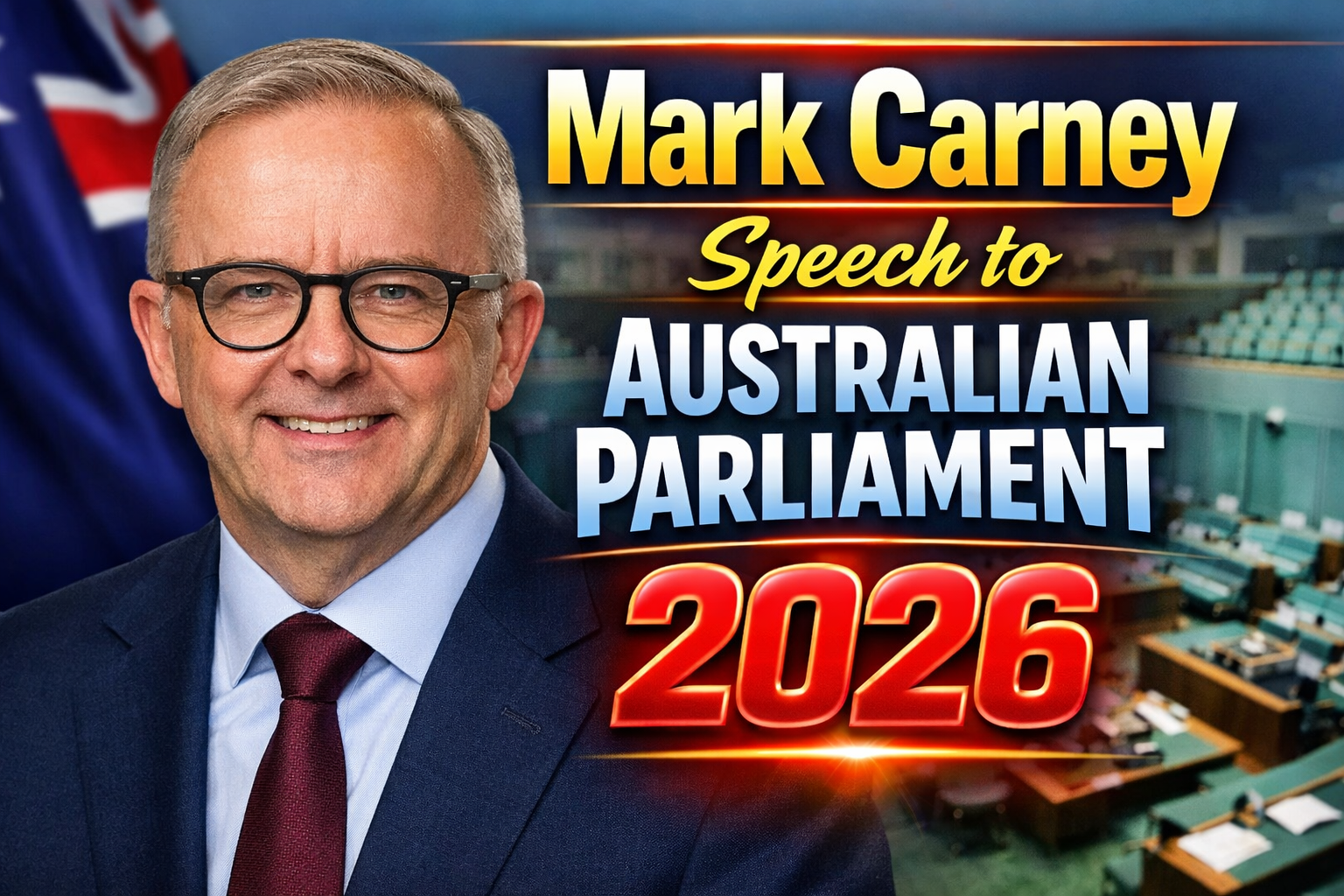
Canadian Prime Minister Mark Carney addressed Australia’s Parliament in Canberra on March fourth, delivering a landmark speech that called for deeper ties between middle powers amid global instability. Australian Prime Minister Anthony Albanese used the occasion to spotlight strengthening defense collaboration, framing the Canada-Australia partnership as vital for navigating turbulent times.
Background to the Historic Address
Mark Carney’s visit marked only the second time a Canadian prime minister spoke to Australia’s Parliament, underscoring elevated bilateral relations. The invitation stemmed from Albanese’s public endorsement of Carney’s Davos speech, where he critiqued the erosion of the rules-based order and advocated middle-power coalitions against economic coercion.
Carney arrived amid shared challenges: US tariff threats under President Trump, supply chain disruptions, and regional security pressures in the Indo-Pacific. Both leaders, Commonwealth heads, emphasized mutual values—democracy, trade openness, resource stewardship—as foundations for expanded cooperation.
The joint appearance followed high-level talks on critical minerals, AUKUS integration, and climate resilience, setting the stage for Carney’s twenty-five-minute address to a packed chamber.
Carney’s Key Themes: A New Global Order
Carney opened with warm praise for Australia, calling it a “beacon of resilience” and hailing Anzac bonds. He warned that traditional alliances face strain as great powers weaponize trade—tariffs on allies, supply chain chokepoints, energy leverage.
“Middle powers can no longer quietly absorb pressure,” Carney declared. “We must build resilient networks—diversified trade, joint defense, shared resources—to shape the order we want.” He spotlighted Canada-Australia synergies: vast mineral deposits for green tech, aligned Pacific interests, complementary militaries.
Without naming the US directly, Carney urged coalitions beyond superpowers: “CANZUK plus ASEAN, APEC middleweights coordinating on standards, not capitulating to unilateralism.” His tone blended economist precision—citing ten percent GDP vulnerability from single-market reliance—with visionary appeal.
Defense Partnership Spotlighted by Albanese
Albanese introduced Carney by detailing defense milestones. Recent pacts expanded joint exercises in northern Australia, with Canadian frigates joining Talisman Sabre twenty twenty-six. HMAS Hobart docked in Esquimalt last month for tech swaps, while RAN submariners train on Canadian systems.
Critical enablers highlighted: shared F-35 fleets, collaborative hypersonic research, and AUKUS Pillar Two—Australia contributes rare earths for Canada’s quantum sensors. Albanese pledged interoperability: “From Arctic patrols to Coral Sea ops, our forces train as one.”
Budget commitments underscored rhetoric: Australia allocates an extra five hundred million for joint bases; Canada invests in Indo-Pacific deployments. Albanese framed it strategically: “In an era of gray-zone threats, our partnership deters aggression, secures sea lanes.”
| Partnership Area | Key Initiatives | 2026 Commitments |
|---|---|---|
| Naval Exercises | Talisman Sabre, RIMPAC expansion | 4 joint ops annually |
| Tech Sharing | F-35 sustainment, drones | $200M pooled R&D |
| Critical Minerals | Lithium, rare earth supply | 10-year MOUs signed |
| Personnel Exchange | Submariner, pilot swaps | 150 exchanges/year |
| Bases/Access | Darwin port for RAN | 5-year rotational access |
Economic Cooperation: Minerals and Trade
Carney detailed economic pillars. Australia supplies seventy percent of Canada’s lithium; joint ventures target EV batteries, renewables. He proposed a Middle Powers Trade Accord—tariff-free criticals, harmonized green standards—to counter coercion.
Albanese echoed: bilateral trade hit ninety billion last year, up twenty percent. New deals cover potash from Saskatchewan for Aussie farms, beef quotas doubled. Carney praised Australia’s Pacific Step-Up, offering Canadian aid matching.
Both critiqued protectionism: “Open markets built prosperity; we reclaim that promise through friends,” Carney stated.
Reactions in Parliament and Public
Labor and Greens applauded Carney’s multilateralism; Liberals welcomed defense focus but probed AUKUS primacy. Nationals pushed rural exports; crossbenchers like David Pocock hailed climate angles.
Media split: progressive outlets lauded “post-US pivot”; conservatives warned over-dependence risks. Social buzz trended #CANZAUK, with polls showing seventy percent public support for ties.
Opposition Leader Sussan Ley congratulated Carney but stressed US alliance bedrock: “Friends diversify, not displace.”
Broader Geopolitical Context
Speech timing aligned with US tariff notices—twenty percent on aluminum—and China maneuvers near Taiwan. Carney invoked Ukraine: “Sanctions evasion thrives without middle-power unity.”
Australia-Canada roles amplify as Quad, Five Eyes anchors. Carney nodded Indo-Pacific Framework, urging ASEAN integration. Albanese highlighted MI6-ASD intel fusion against hybrid threats.
Global middle powers watch: UK’s Starmer eyes similar address; NZ signals in.
Implications for Australia-Canada Relations
Immediate wins: Q2 MOU on quantum defense tech; joint critical minerals taskforce. Long-term: CANZUK formalization—mobility, procurement standards.
Defense evolves from episodic to structural: shared satellite constellations, AI targeting. Economic resilience grows via stockpiles, diversified suppliers.
Challenges persist: Canada’s Arctic focus versus Australia’s maritime priorities; reconciling EU ties.
Shared Challenges: Climate and Security
Carney wove climate urgency: Pacific rising seas demand joint aid; bushfire lessons inform Canadian wildfires. Albanese touted net-zero militaries—solar bases, EV fleets.
Hybrid threats unified agendas: cyber from non-state actors, disinformation countered via joint centers.
Future Roadmap and Commitments
Leaders unveiled twenty twenty-six action plan:
- Defense: Two new bases, annual ministerials.
- Trade: Twenty billion target by twenty twenty-eight.
- People: Working holiday doubled to five years.
- Innovation: Co-fund AI, biotech hubs.
Albanese closed: “Mark, your words inspire action. Together, we don’t just endure—we lead.”
Why This Matters for Australia
Amid US unpredictability, Canada offers reliable heft—G7 economy, battle-tested forces. Partnership buffers trade shocks, bolsters deterrence without new foes.
Public gains: cheaper EVs from mineral chains, job-creating exports. Strategic depth reassures voters facing China hawks.
Global Ripple Effects
Carney’s vision catalyzes: Japan, South Korea signal interest; EU mulls associate status. Middle powers reclaim agency, reshaping alliances incrementally.
Trump’s team dismissed as “club of losers”; Beijing watches warily.
Conclusion: A Partnership for Uncertain Times
Carney’s address and Albanese’s framing cement Australia-Canada as exemplars—pragmatic, values-driven. From parliamentary podium to Pacific patrols, ties deepen, fortifying both against flux.

Lance Evans is a contributor at CSKHYBER.co.nz covering New Zealand and Australia news, with a focus on trending updates and public-interest stories.