
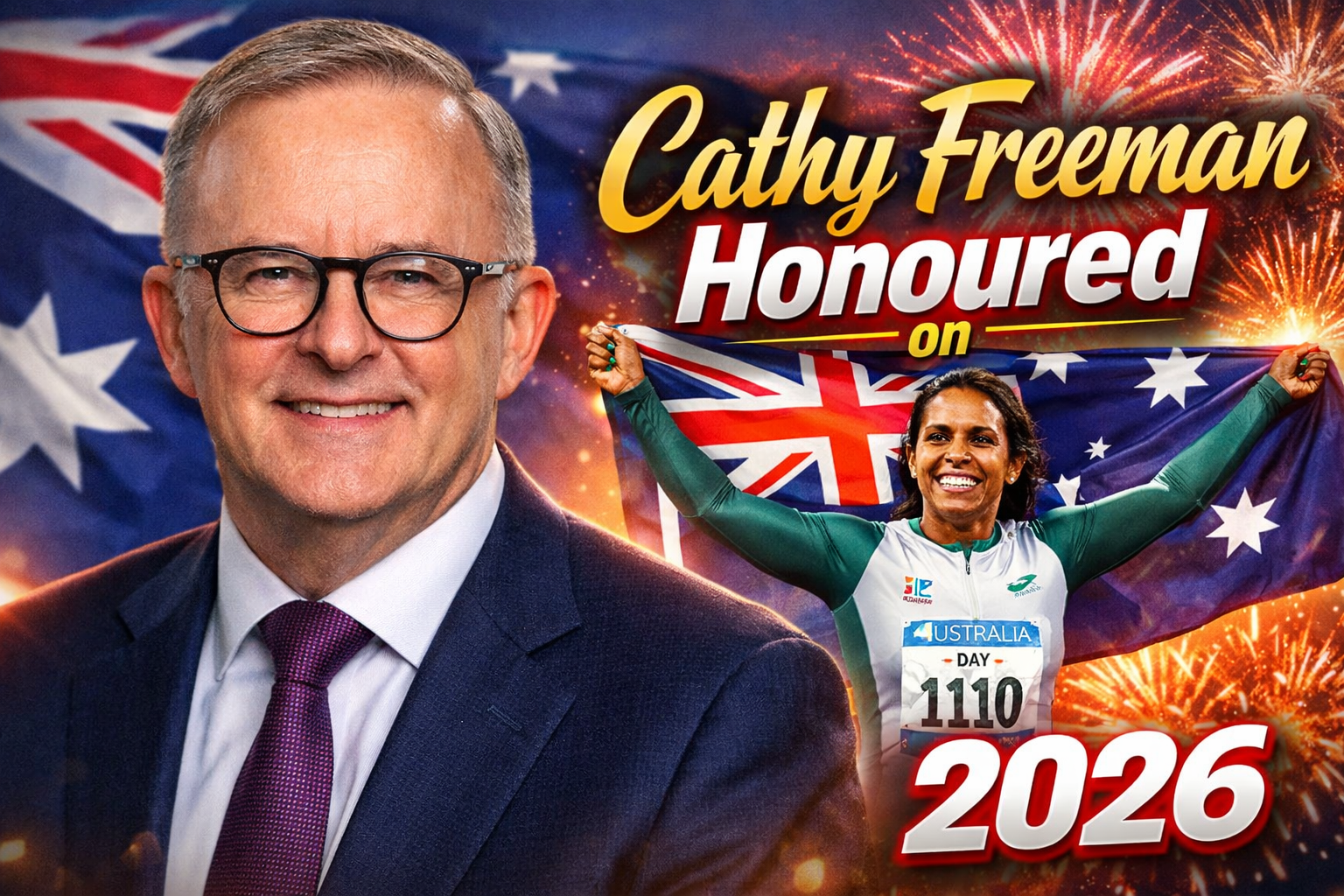
Cathy Freeman, Australia’s sprinting legend and symbol of Indigenous pride, has been awarded the nation’s highest civilian honour on Australia Day 2026. This Companion of the Order of Australia recognises her extraordinary athletic achievements, tireless advocacy for reconciliation, and lifelong commitment to uplifting young Indigenous Australians.

Introduction
Australia Day always shines a spotlight on those who embody the nation’s spirit, and this year, Cathy Freeman stands tallest among them. At 52 years old, the golden girl of the Sydney Olympics has transitioned from track sensation to a beacon of hope, earning the rare Companion of the Order of Australia (AC)—one of just ten such awards given nationwide. This honour caps a career that transcended sport, blending personal triumph with profound social impact. Freeman’s journey from a young Aboriginal girl in Mackay, Queensland, to global icon reflects Australia’s evolving story of resilience, diversity, and unity.
Her recognition arrives amid celebrations marking the nation’s character, where nearly 700 individuals received honours across categories. Freeman’s award highlights her dual legacy: dominating the 400-metre dash and championing First Nations causes. As Brisbane gears up for the 2032 Olympics, her story reignites dreams of what Indigenous excellence can inspire.
Early Life and Rise to Fame
Born in 1973 on the palm-fringed coast of Queensland, Cathy Freeman grew up in a world shaped by her Murri heritage. Her family faced the harsh realities of remote Indigenous life—limited opportunities, systemic barriers, and a fight for identity. Yet sport became her escape and equalizer. By age 14, she caught the eye of coaches at the Australian Institute of Sport, her raw speed turning heads.
Freeman burst onto the international stage at the 1990 Commonwealth Games in Auckland. Just 16, she anchored Australia’s victorious 4x100m relay team, becoming the first Indigenous Australian to claim Commonwealth gold. The moment etched her name in history, but it was only the start. She followed with individual silvers in the 200m and 400m, signaling a prodigy in the making.
Olympic Glory in Sydney
No chapter defines Freeman more than the Sydney 2000 Olympics. As the home crowd roared, she entered Stadium Australia carrying the weight of a nation’s hopes. In the women’s 400m final, Freeman unleashed a flawless performance—51.81 seconds, pure poetry in motion. She crossed the line first, then draped herself in both the Australian and Aboriginal flags during her victory lap, a defiant act of dual pride that divided and united the country.
That lap symbolized reconciliation at its rawest. Critics called it political; supporters hailed it as healing. Freeman later won 400m gold at the World Championships in 1997 and 1999, amassing four Commonwealth golds overall. Her stats paint a champion: over 20 major international medals, including Olympic gold in the 4x400m relay. Yet Sydney remains etched in collective memory, with viewership peaking at 75 percent of Australians glued to screens.
| Career Highlights | Event | Year | Achievement |
|---|---|---|---|
| Commonwealth Games | 4x100m Relay | 1990 | Gold (First Indigenous winner) |
| World Championships | 400m | 1997 | Gold |
| World Championships | 400m | 1999 | Gold |
| Olympics | 400m | 2000 | Gold (Personal best: 51.81s) |
| Olympics | 4x400m Relay | 2000 | Gold |
| Commonwealth Games | 400m | 2002 | Gold |
This table captures her dominance, where speed met destiny. Post-Sydney, Freeman retired at her peak, choosing legacy over longevity.
Advocacy and Social Impact
Freeman never sprinted alone; her cause was always bigger. She leveraged fame to spotlight Indigenous struggles—education gaps, health disparities, and cultural erasure. In 2003, she launched the Cathy Freeman Foundation (now Murrup Foundation), targeting remote Aboriginal and Torres Strait Islander children. The initiative provides scholarships, mentoring, and resources, helping thousands access quality education.
Statistics underscore the need: Indigenous high school completion rates lag 20-30 percentage points behind non-Indigenous peers, with remote areas faring worse. Murrup bridges this, funding literacy programs and leadership camps. Freeman’s hands-on role—visiting communities, sharing her story—amplifies its reach. “Education lit my path,” she often says. “It’s the key for every child.”
Her reconciliation efforts peaked during the 2000 Olympics, but endured. Freeman backed the 2023 Voice referendum, urging unity despite its defeat. She mentors young athletes, emphasizing mental health alongside medals. In a nation grappling with its past, her voice fosters dialogue, proving one person’s platform can shift paradigms.
The Australia Day Honour
Announced on the eve of Australia Day 2026, Freeman’s AC award salutes “eminent service to athletics, positive social influence, reconciliation efforts, and youth inspiration.” One of five women among ten recipients, she joins figures like former Queensland Premier Annastacia Palaszczuk. The list honoured nearly 700, with Medals of the Order (OAM) dominating at 472, followed by 38 Officers (AO) and 108 Members (AM).
Freeman’s reaction was pure humility: “It’s truly humbling—it fuels my fire for what’s next.” At 52, she eyes Brisbane 2032 as a “fantastic chance” for new Indigenous stars. The honour arrives amid debates over Australia Day’s date, yet Freeman embodies its inclusive potential. Ceremonies in coming months will see her investiture, a formal nod to enduring impact.
Gender balance drew scrutiny—72 percent male recipients prompted calls for more female nominations. Freeman’s nod counters this, spotlighting women driving change.
| 2026 Honours Breakdown | Category | Recipients |
|---|---|---|
| Companion (AC) | Highest tier | 10 |
| Officer (AO) | Leadership | 38 |
| Member (AM) | Service | 108 |
| Medal (OAM) | Community | 472 |
| Total | All categories | ~680 |
This snapshot reveals the honours’ breadth, with Freeman at the pinnacle.
Legacy and Future Influence
Freeman’s imprint spans generations. She shattered stereotypes, proving Indigenous Australians could conquer global stages. Young runners in Alice Springs or Cairns cite her as muse; her foundation has empowered over 5,000 kids since inception. Beyond stats, her legacy is cultural—flying both flags normalized pride in duality.
Critics once questioned her activism; today, it’s celebrated. Freeman’s post-athletics life—motherhood, business ventures, public speaking—shows sustained grace. She navigates fame quietly, focusing on quiet wins like literacy rates rising in Murrup communities.
Looking ahead, Brisbane 2032 looms large. Freeman dreams of another golden moment for First Nations athletes, perhaps in her beloved 400m. Her honour cements her as a national treasure, urging Australia toward fuller reconciliation. In her words: “We all want a brighter future—young people see me as proof it’s possible.”
Personal Reflections and Tributes
Freeman’s family roots her story. Grandmother’s activism in the 1960s Freedom Rides influenced her fire. Husband James transcribes her energy into family life with daughter Grace. Tributes poured in: Prime Minister called her “Australia’s daughter,” while Olympians past and present hailed a pioneer.
Indigenous leaders praised her bridge-building. “Cathy ran for us all,” said one elder. Her humility shines: no ego, just purpose. As Australia Day fireworks lit 2026 skies, Freeman’s star burned brightest, a reminder that true heroes sprint for others.
Conclusion
Cathy Freeman’s Australia Day 2026 honour is more than personal—it’s communal vindication. From Mackay tracks to Olympic podiums, her path illuminates possibility. In a land of vast contrasts, she unites through speed, spirit, and service. As Murrup grows and new runners lace up, Freeman’s flame endures, propelling Australia forward.

Lance Evans is a contributor at CSKHYBER.co.nz covering New Zealand and Australia news, with a focus on trending updates and public-interest stories.