

Australia’s foreign policy amid the escalating Iran conflict balances strong support for allies like the United States and Israel with calls for restraint and diplomatic resolution. Prime Minister Anthony Albanese’s government condemns Iran’s nuclear ambitions and regime while firmly ruling out direct military involvement.
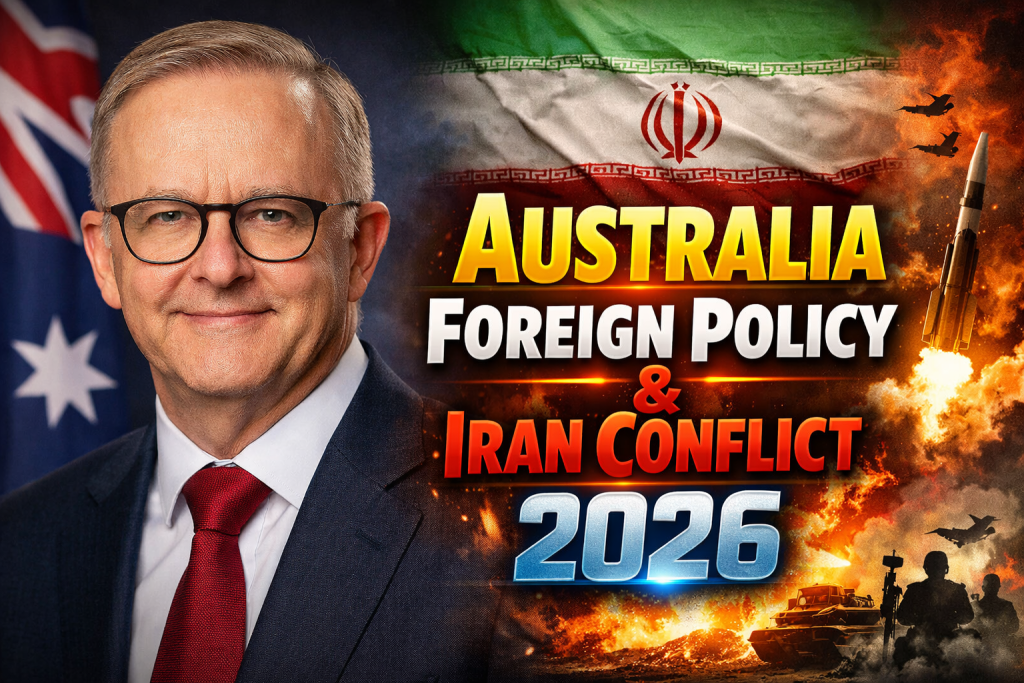
Escalation of the Iran Conflict
The Iran crisis intensified in late February 2026 when the United States and Israel launched precision strikes on Iranian nuclear facilities and military sites. Iranian state media reported attacks across Tehran and other cities, with smoke visible over the capital. Iran retaliated with missile barrages targeting Israeli positions and even Dubai, unrelated to the strikes.
Reports emerged of the death of Iran’s Supreme Leader during an assault, marking a potential turning point. President Donald Trump indicated U.S. operations could continue for weeks, reporting initial American casualties. Proxy groups backed by Iran, including Hezbollah and Houthis, heightened regional tensions through coordinated actions.
This marks the most direct confrontation since past proxy wars, driven by Iran’s advancing ballistic missile program and uranium enrichment nearing weapons-grade levels.
Australia’s Historical Relations with Iran
Bilateral ties soured dramatically after Iran-orchestrated attacks on Australian soil in 2024, targeting the Jewish community. These incidents prompted unprecedented responses: expulsion of Iran’s ambassador—the first since World War II—suspension of Australia’s Tehran embassy, and designation of the Islamic Revolutionary Guard Corps as a terrorist entity.
Australia imposed sanctions on over two hundred Iranian-linked individuals, primarily IRGC affiliates. Trade, already minimal, halted entirely. This history shapes Canberra’s hawkish stance, viewing Iran as a direct security threat.
Official Government Stance
Prime Minister Albanese articulated Australia’s position clearly: support for U.S. actions to prevent Iran acquiring nuclear weapons, while standing with the Iranian people against oppression. He described the regime as destabilizing through nuclear pursuits, proxy support, antisemitism, and violence.
Foreign Minister Penny Wong echoed this, emphasizing Iran’s threats to global peace. The government convened National Security Cabinet meetings to monitor developments. Official statements stress diplomatic preferences but back allied efforts to curb nuclear proliferation.
Australia rules out military participation explicitly. Defense Minister Richard Marles confirmed no involvement in ongoing U.S.-Israeli operations, prioritizing citizen evacuations.
Key Official Statements Table
| Official | Date | Core Message |
|---|---|---|
| PM Albanese | Feb 27, 2026 | Stands with Iranians against oppression; supports US preventing nuclear Iran |
| FM Wong | Feb 28, 2026 | Regime destabilizing; backs strikes to avert nuclear threat |
| Def Min Marles | Mar 2, 2026 | No Australian military role in conflict |
| Joint Statement | Feb 28, 2026 | Expulsions, sanctions justified; monitor escalation |
Diplomatic Measures and Actions Taken
Post-2024 attacks, Australia severed high-level diplomatic channels. Embassy closure limits consular aid, urging citizens to leave Iran immediately. Travel warnings escalated to “do not travel,” with Smartraveller advising departure via safe routes.
Sanctions regime expanded, targeting IRGC funding networks. Australia coordinates with Five Eyes partners on intelligence sharing. At the UN, Canberra pushes resolutions condemning Iran’s nuclear defiance and proxy terrorism.
Multilateral engagement includes joint statements with Canada and the EU, calling for de-escalation while isolating Tehran.
Military and Security Policy
Australia commits no troops or assets to the conflict, diverging from past Middle East involvements like Iraq. Focus shifts to Indo-Pacific priorities under AUKUS, viewing Iran as peripheral but ideologically linked via shared threats like terrorism.
Enhanced border security counters potential reprisals; ASIO warns of lone-actor risks targeting Jewish sites. Naval patrols in key sea lanes protect trade routes indirectly affected by Houthi disruptions.
Defense spending rises, but allocations favor submarines and hypersonics over Middle East deployments.
Economic Impacts and Sanctions
Minimal direct trade exposure shields Australia—Iran exports negligible. Energy markets fluctuate: oil prices spiked ten percent post-strikes, benefiting LNG exporters like Australia amid global rerouting.
Sanctions enforcement tightens on dual-use goods. Financial institutions screen Iran-linked transactions rigorously. Broader effects hit via shipping delays in the Gulf, raising import costs modestly.
Economic Snapshot Table
| Sector | Impact Description | Projected Change |
|---|---|---|
| Energy Exports | Higher LNG demand from Europe/Asia | +8% revenue boost |
| Oil Imports | Price volatility | +12% short-term hike |
| Trade Volume | Negligible bilateral; indirect disruptions | Minimal |
| Sanctions Compliance | IRGC asset freezes | 200+ entities targeted |
Domestic Political Reactions
Coalition Leader Angus Taylor condemned Iran as authoritarian and terrorist-backing, praying for regime change. Bipartisan consensus holds on non-intervention and sanctions.
Greens urge pure diplomacy, criticizing U.S. strikes as escalatory. Public opinion splits: polls show sixty percent support allied actions, thirty oppose escalation. Jewish community groups applaud firm stance; Iranian-Australians voice regime fears.
Media coverage amplifies travel alerts amid flight cancellations to the region.
International Alliances and Coordination
Alignment with U.S., UK, Israel remains core—Albanese affirms ANZUS solidarity sans boots on ground. AUKUS consultations occur, linking Iran nuclear tech to Pacific threats.
EU and UK temper support, urging restraint; Australia mediates somewhat. Quad partners (US, Japan, India) share intel on proliferation risks. China critiques strikes; Australia rebuffs, prioritizing sovereignty.
G20 forums loom for post-conflict reconstruction talks.
Humanitarian Concerns and Aid
Limited aid focuses on Iranian civilians via UNHCR channels. Emphasis: support dissidents non-violently. Consular crisis teams assist stranded Australians—hundreds urged evacuation.
Refugee policy tightens for Iranians fleeing regime, prioritizing genuine cases. Advocacy for oppressed minorities, including Jews and women, integrates into statements.
Future Outlook and Policy Implications
Conflict trajectory uncertain: regime collapse possible post-leader death, or hardened retaliation. Australia prepares scenarios—diplomatic push for talks if openings arise, sustained sanctions otherwise.
Foreign policy recalibrates: bolstering alliances, investing in missile defense. Indo-Pacific focus sharpens, seeing Iran’s model as cautionary. Long-term, nuclear non-proliferation advocacy intensifies at IAEA.
Albanese’s balanced approach—rhetorical support, zero combat—preserves credibility. Escalation risks low for Australia, but vigilance essential.
Challenges and Criticisms
Critics decry selective outrage, ignoring Palestinian issues. Legal scholars question strikes’ lawfulness, urging Australia speak on international norms. Resource strains from consular ops noted.
Opposition probes government preparedness. Public fatigue from global crises grows, favoring domestic priorities.
Global Context and Australia’s Role
As middle power, Australia punches above weight via alliances. Iran conflict tests post-Afghanistan aversion to quagmires. Success: influencing outcomes without entanglement.
Broader lesson: proactive sanctions deter aggressors. Carney’s recent visit underscores diversification from volatile regions.

Lance Evans is a contributor at CSKHYBER.co.nz covering New Zealand and Australia news, with a focus on trending updates and public-interest stories.