
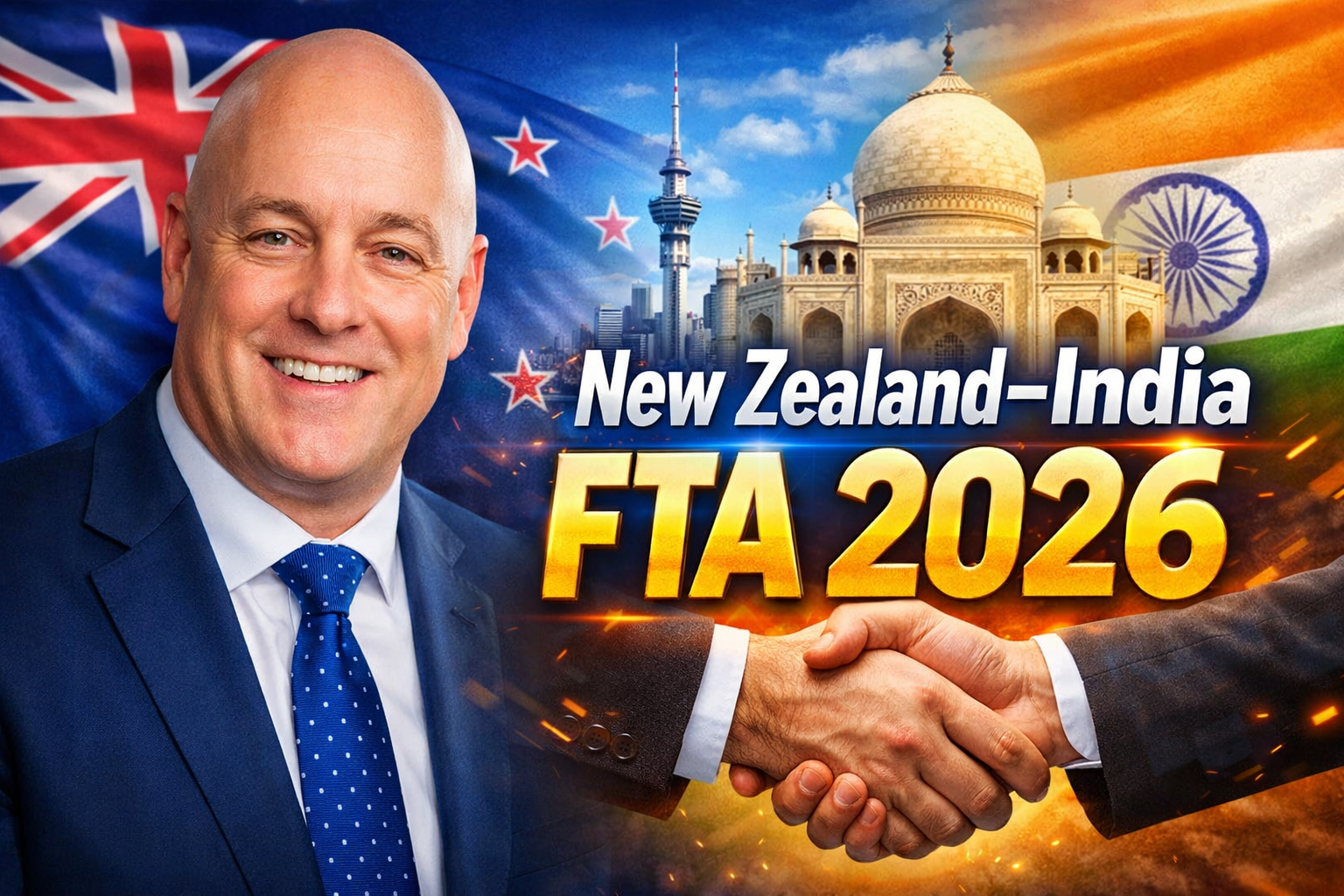
New Zealand and India are set to bring their new Free Trade Agreement (FTA) into force in 2026, but dairy – the backbone of New Zealand’s export economy – remains almost entirely outside the deal. The agreement still delivers significant tariff cuts, investment promises, and processing opportunities that will reshape parts of the trans‑Tasman dairy value chain and broader agri‑trade, even though consumer dairy access into India is blocked.
Overview of the 2026 New Zealand–India FTA
The India–New Zealand FTA was politically agreed in late 2025 and is slated to take effect in 2026 after ratification and domestic procedures in both countries. It aims to roughly double bilateral trade within five years by granting near zero‑duty access for Indian goods into New Zealand and substantial tariff liberalisation on a large share of New Zealand exports to India.
India has treated dairy as a “red‑line” sector, refusing any duty cuts on core dairy imports while using the rest of the agreement to advance manufacturing, services, and investment interests. For New Zealand, this marks the first FTA where core dairy products are completely excluded from tariff concessions, a striking departure given that dairy typically accounts for about 30 percent of its total exports.
How Dairy Is Treated in the FTA
The FTA explicitly keeps consumer dairy products such as fluid milk, cheese, butter, yoghurt, cream and most finished dairy items outside India’s tariff commitments. Existing Indian import duties on these products – which can be 30–60 percent or higher when surcharges and taxes are included – therefore remain fully in place for New Zealand exporters.
However, the agreement creates a tightly ring‑fenced channel for New Zealand companies to bring dairy inputs into India for processing and compulsory re‑export. Under this arrangement, 100 percent of finished dairy goods produced from New Zealand inputs in India must be exported to third markets, with no diversion allowed into the Indian domestic market.
Key Dairy Provisions at a Glance
India’s commerce minister has repeatedly stressed that there are “no duty concessions on dairy imports” in the FTA and that this stance will not change, answering domestic fears about cheap foreign milk undermining millions of small farmers.
Current Dairy Trade Baseline Between New Zealand and India
Despite New Zealand’s dominance in global dairy exports, its direct dairy trade with India is tiny. In FY2025, New Zealand’s dairy exports to India were just over 1 million USD, covering a mix of milk and cream, butter, mozzarella cheese, honey and skimmed milk powder.
India, by contrast, has emerged as both a massive producer and a growing exporter of dairy products, with dairy exports surging by around 80 percent in 2024–25 to nearly 493 million USD. Indian dairy supports more than 80 million households and is deeply tied to rural livelihoods, which explains why Delhi has consistently blocked dairy concessions in RCEP and other trade talks as well.
New Zealand’s broader two‑way trade with India, across all goods and services, was about 3.1–3.2 billion NZD in 2024, with New Zealand exports at roughly 700–720 million NZD focused on wool, logs, apples and limited dairy. The FTA aims to roughly double that total, though most of the growth will not come from consumer dairy shipments into India.
Major Dairy Trade Updates Under the FTA
While consumer market access is off the table, several important dairy‑related changes will still flow from the FTA framework. These changes relate mainly to inputs, processing, and specific higher‑value segments like infant formula rather than retail milk or cheese.
First, India has agreed to a fast‑track mechanism under which New Zealand dairy inputs can enter duty‑free for processing in designated export‑oriented units, provided the end products are exported entirely out of India. This effectively makes India a potential low‑cost processing platform for New Zealand brands targeting Asia, the Middle East, or Africa, combining New Zealand raw materials with Indian manufacturing and packaging capacities.
Second, some specialised dairy‑related tariff lines – particularly industrial ingredients and infant‑formula‑type preparations – receive gradual concessions or quota‑style arrangements in New Zealand’s schedules, though these mainly benefit Indian exporters and investors. High‑value proteins such as milk albumins will see tariff cuts of around 50 percent within a New Zealand‑specific quota roughly equal to current export volumes, opening a niche but important channel.
Illustrative Dairy‑Relevant Tariff Outcomes
These measures collectively nudge the structure of dairy trade toward investment‑led and processing‑focused models rather than simple bulk exports into India.
Market Impact on New Zealand’s Dairy Sector
For New Zealand dairy farmers and processors, the FTA’s biggest impact may be psychological and strategic rather than immediate in volumes. India is widely seen as a “missing piece” in New Zealand’s FTA portfolio, but this deal confirms that full dairy access to India will not be unlocked in the medium term.
Domestic critics in New Zealand, including some farmer groups and coalition partners in government, argue that signing an FTA without core dairy concessions undermines the country’s negotiating leverage and prioritises India’s labour‑intensive sectors over New Zealand’s most competitive export. However, supporters counter that the agreement still opens doors for meat, wool, forestry, seafood and services, while at least carving out an innovative – if narrow – pathway for dairy inputs and processing in India.
In practical terms, core farmgate milk demand in New Zealand will not suddenly spike because access to India remains constrained, so farmers are unlikely to see a meaningful price premium directly attributable to the FTA. Large processors like Fonterra and independent exporters may instead focus on using India as a supplementary processing and value‑addition hub, especially for products destined for the Gulf, Africa or Southeast Asia, where India offers cost and logistics advantages.
Market Impact on India’s Dairy Ecosystem
India’s dairy sector gains a significant policy victory: the FTA showcases that New Delhi can sign a “high quality” trade pact with a developed, dairy‑heavy economy without opening its own dairy market. This reinforces India’s broader strategy of protecting sensitive sectors in trade agreements after its withdrawal from RCEP over similar dairy and agriculture concerns.
By preserving import barriers, India shields around 80 million dairy‑dependent households from a potential influx of cheap New Zealand milk and milk powder that could depress farm‑gate prices. At the same time, Indian firms can benefit from New Zealand investment and technology transfer into export‑oriented dairy plants operating under the ring‑fenced processing model.
Indirectly, the FTA may also encourage India’s own outbound dairy exports, which have already surged nearly 80 percent in 2024–25, by linking Indian processors more closely into New Zealand‑anchored global supply chains. Yet domestic consumers are unlikely to see cheaper imported cheese or butter from New Zealand on supermarket shelves, because the policy intent is to keep dairy imports tightly controlled.
Strategic Implications for the Wider Dairy Market
For global dairy markets, the New Zealand–India FTA underlines a broader trend: large emerging economies can secure comprehensive FTAs while ring‑fencing politically sensitive food sectors. New Zealand’s willingness to sign under these terms may influence how future agricultural exporters approach India and other populous markets, knowing that dairy liberalisation is far from guaranteed.
At the same time, the agreement’s emphasis on processing and re‑export illustrates a new model of “triangular” dairy trade, where New Zealand supplies raw material, India adds processing and manufacturing value, and third countries receive the final product. This could gradually reshape investment patterns, with more New Zealand dairy capital and know‑how flowing into Indian facilities even without direct access to Indian consumers.
Looking into 2026 and beyond, the FTA’s dairy chapter is best seen as a compromise: New Zealand accepts no immediate consumer market access in exchange for broader trade and investment gains, while India secures growth and technology flows without jeopardising its rural dairy base. For the dairy industry on both sides, the real test will be how effectively they leverage the limited processing window and tariff niches, rather than waiting for a sudden opening of India’s domestic market.

Lance Evans is a contributor at CSKHYBER.co.nz covering New Zealand and Australia news, with a focus on trending updates and public-interest stories.