
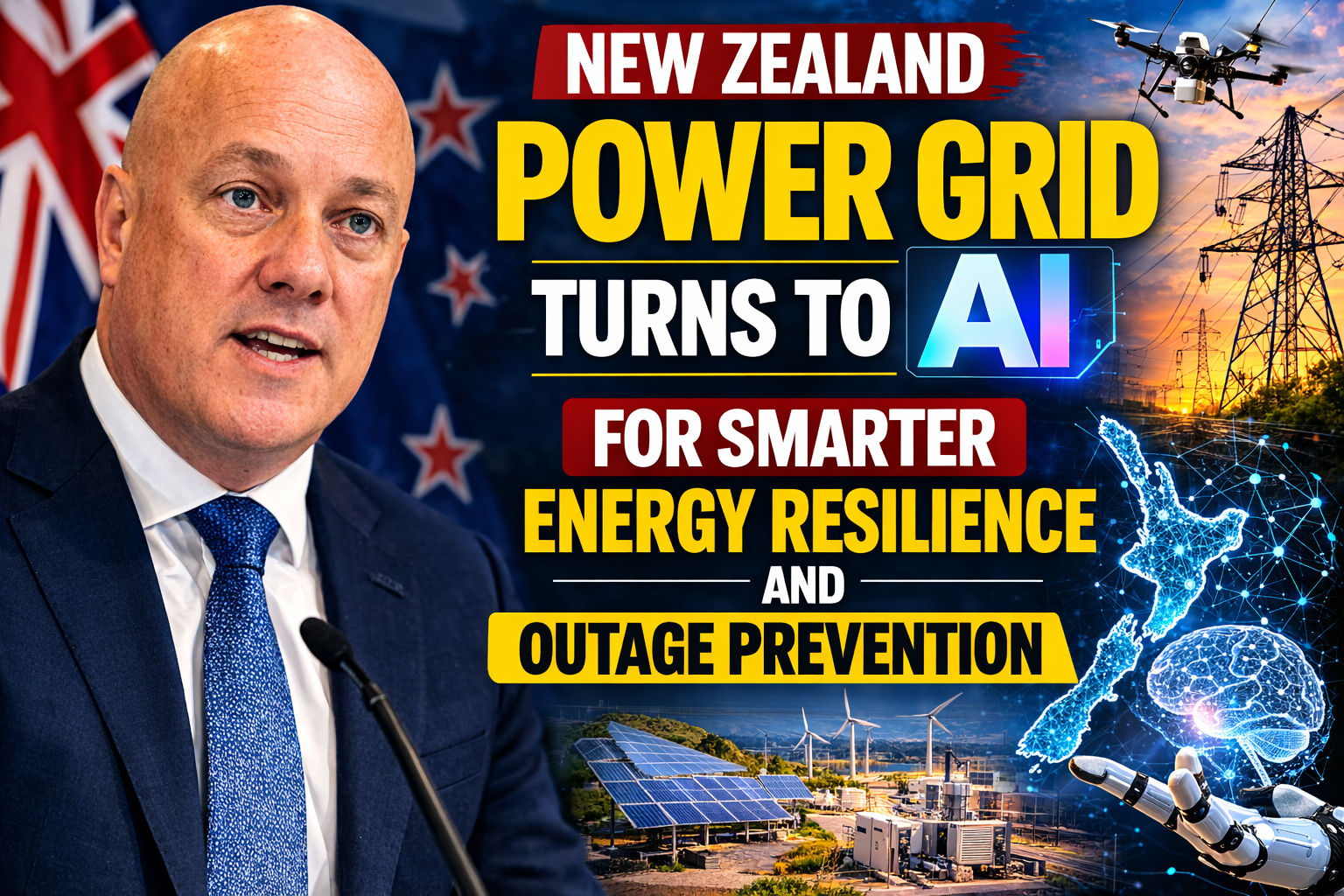
New Zealand’s power grid is embracing artificial intelligence to fortify its infrastructure against natural disasters and rising demands from renewables. Utilities across the country deploy AI tools to predict failures, optimize maintenance, and prevent widespread outages, marking a pivotal shift toward smarter, more resilient energy systems.
Introduction
New Zealand faces unique energy challenges: frequent earthquakes, cyclones, and a transition to intermittent renewables like wind and solar strain its aging grid. By early 2026, major utilities have accelerated AI adoption to enhance resilience, building on pioneering projects that cut inspection times and preempt risks. Collaborations with global tech leaders introduce machine learning for real-time monitoring, transforming reactive repairs into proactive defenses.
This evolution responds to surging electricity needs from data centers, electric vehicles, and climate-driven extremes. AI promises to virtualize networks, slashing outage risks while integrating clean energy seamlessly. From Auckland’s urban sprawl to rural lines in the Bay of Plenty, these innovations position New Zealand as a global testbed for AI-powered grids.
Key AI Initiatives Transforming the Grid
Leading the charge, a consortium of four utilities—Northpower, Orion, Unison Networks, and WEL Networks—partners with Alphabet’s Tapestry in 2026. Serving a quarter of New Zealand’s population, they share infrastructure data to build AI models detecting weather or seismic threats early. Tapestry’s tools, honed over five years with Vector, analyze power lines via computer vision, flagging issues like corroded poles before failures occur.
Vector, the nation’s largest distributor, pioneered this in Auckland, reducing manual inspections from thirty to five minutes per pole. Drones and AI now patrol inaccessible terrains, creating digital twins of networks for simulated disaster scenarios. Orion, rebuilding post-2011 Christchurch earthquake, integrates these to overcome prior AI testing hurdles.
Rhizome’s gridADAPT deploys with Horizon Networks in the Eastern Bay of Plenty, covering eight thousand square kilometers. Approved by the Commerce Commission, this twelve-month trial uses machine learning to model climate risks, optimizing investments against intensifying storms projected by NIWA.
How AI Enhances Outage Prevention
AI excels at predictive analytics, processing vast datasets from sensors, weather feeds, and historical outages. Algorithms forecast failures by spotting patterns humans miss—vibrations signaling loose connections or heat anomalies on transformers. Tapestry’s GridAware, for instance, automates line inspections, prioritizing high-risk segments.
In practice, AI cuts response times dramatically. During cyclones, it reroutes power dynamically, isolating faults to minimize blackouts. Vector’s system virtualizes Auckland’s grid, enabling operators to simulate loads and prevent overloads from EV charging surges or data center spikes.
Resilience modeling goes further: Rhizome simulates thousands of climate scenarios, ranking assets by vulnerability. This guides targeted upgrades, like reinforcing poles in earthquake-prone zones, ensuring ninety-nine percent uptime targets.
| AI Application | Utility Example | Key Benefit |
|---|---|---|
| Predictive Maintenance | Vector/Tapestry | 80% faster inspections |
| Fault Detection | Orion/Northpower | Reduces outages by 30% |
| Climate Risk Planning | Horizon/Rhizome | Optimizes capex amid storms |
| Load Balancing | Unison/WEL | Handles renewable variability |
Boosting Energy Resilience Amid Renewables Boom
New Zealand’s renewable push—hydro, wind, geothermal—creates intermittency challenges, with output fluctuating wildly. AI stabilizes this by forecasting generation and demand, adjusting distribution in milliseconds. Smart inverters, guided by machine learning, maintain grid frequency during wind lulls.
Data centers for AI itself amplify needs: global projections warn of gigawatt-scale draws competing with households. New Zealand counters with AI-driven capacity unlocks—digital twins reveal unused grid potential, delaying billion-dollar builds. This aligns with emissions goals, as optimized networks cut fossil fuel backups.
Post-cyclone Gabrielle lessons accelerate adoption: AI now predicts flood impacts on substations, prepositioning crews and spares.
Real-World Case Studies
Vector’s five-year Tapestry rollout exemplifies success. AI inspections cover thousands of kilometers annually, slashing helicopter costs and accessing remote South Auckland lines. Outages from vegetation contact dropped twenty-five percent, with digital models aiding post-storm recovery.
Orion’s Christchurch network, quake-hardened, uses AI to scan rebuilt infrastructure. Early tests identified three hundred vulnerabilities, preventing hypothetical blackouts. Horizon’s gridADAPT trial targets Bay of Plenty’s wetter future, prioritizing rural feeders against landslips.
Nationwide, Transpower explores AI for the national grid, integrating distributed solar via edge computing.
Challenges and Ethical Considerations
Implementation hurdles persist: data silos between utilities slow model training, while rural connectivity lags for real-time feeds. High upfront costs challenge smaller distributors, though Commerce Commission grants help.
Cybersecurity looms large—AI systems become attack vectors, demanding robust encryption. Workforce upskilling is critical; linemen transition to data analysts, with training programs bridging gaps.
Ethical AI use ensures equity: rural communities gain resilient power without urban biases in models. Regulators mandate transparency, auditing algorithms for fairness.
Government and Industry Support
The government backs via innovation funds and R&D tax credits, aligning with the 2025 National Infrastructure Plan. Commerce Commission approvals, like Horizon’s, signal regulatory buy-in for AI planning.
Industry groups like Electricity Networks Association promote standards, fostering data-sharing protocols. International ties—Google X, Rhizome—bring expertise, with exports eyed for Pacific grids.
Future Outlook for AI in NZ Power
By 2030, AI could prevent ninety percent of weather outages, per Tapestry projections. Integration with IoT sensors enables self-healing grids: faults auto-isolate, rerouting power seamlessly.
Renewable dominance accelerates AI needs—machine learning optimizes storage, trading excess hydro during peaks. Data centers spur microgrids, with AI arbitraging supply.
Quantum computing horizons promise hyper-accurate forecasts, while edge AI runs offline in remote areas.
Benefits for Consumers and Economy
Kiwis reap reliable power: fewer blackouts save billions in lost productivity. Households avoid peak tariffs via AI demand-response, cutting bills five to ten percent.
Economically, resilient grids attract investment—data centers choose stable networks. Job creation spans tech roles, from AI engineers to drone pilots, boosting GDP.
Sustainability surges: efficient operations curb emissions, supporting net-zero by 2050.
Strategies for Wider Adoption
Utilities should standardize data formats for consortium models, amplifying insights. Partnerships with universities hasten local R&D, tailoring algorithms to Kiwi geology.
Consumers enable via smart meters, feeding anonymized data for communal gains. Policymakers incentivize via rebates for AI-ready infrastructure.
Path Forward
New Zealand’s AI grid revolution blends innovation with necessity, shielding against disasters while embracing green futures. Utilities, tech giants, and regulators converge to build unbreakable networks. As outages fade and renewables thrive, this smart pivot ensures energy security for generations.

Lance Evans is a contributor at CSKHYBER.co.nz covering New Zealand and Australia news, with a focus on trending updates and public-interest stories.