
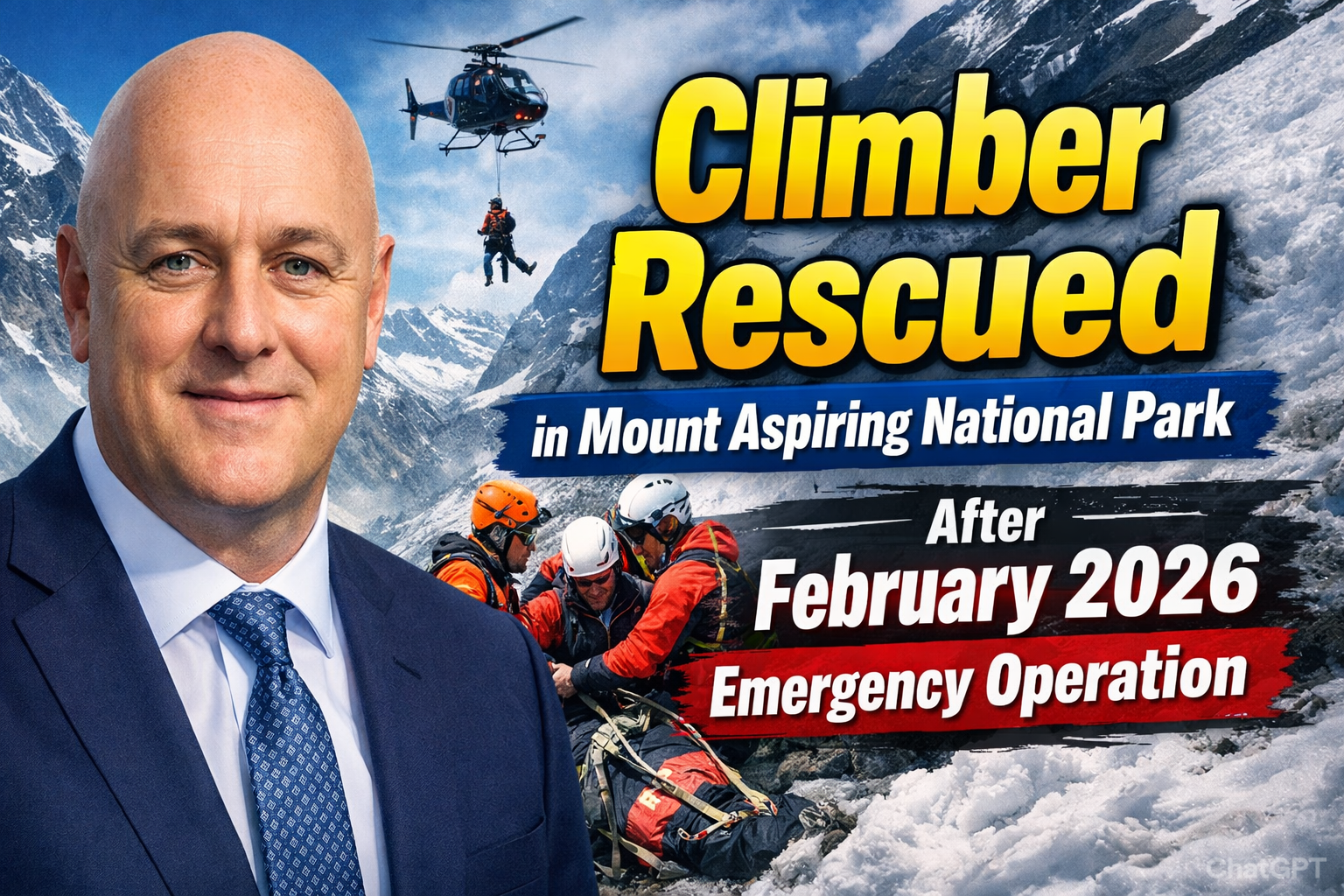
A harrowing climber rescue unfolded in Mount Aspiring National Park on February 14, 2026, when a fall on Mount Brewster triggered a swift multi-agency operation. The injured individual, unable to walk after plummeting on icy terrain, activated a personal locator beacon at 3:25 pm, prompting an immediate airlift to safety.
Coordinated by Maritime New Zealand’s Rescue Coordination Centre, the mission highlighted the perils of alpine climbing in New Zealand’s rugged Southern Alps. This event underscores the park’s reputation as a world-class yet unforgiving playground for adventurers.
Park and Peak Overview
Mount Aspiring National Park spans 3,562 square kilometers in the Otago region, encompassing jagged peaks, glaciers, and fiords like the Routeburn Valley. Established in 1964 and declared a UNESCO World Heritage site in 1990, it attracts over 100,000 visitors yearly for tramping, climbing, and heli-skiing.
Mount Brewster, at 2,513 meters, rises dramatically near the Brewster Glacier, part of the park’s southwest circuit. Its steep ridges and crevassed approaches demand advanced skills, with routes like the Southwest Ridge rated grade 4 alpine. Weather shifts rapidly, with winds exceeding 100 km/h and snowfalls common even in summer.
The area symbolizes raw New Zealand wilderness, home to kea birds and ancient podocarps, but its remoteness amplifies rescue challenges.
Incident Details
Two climbers ascended Mount Brewster’s challenging faces when one tumbled, sustaining injuries that left them immobile. The partner assisted initially, but deteriorating conditions necessitated the beacon activation—a satellite device beaming GPS coordinates globally.
Such falls often stem from rockfall, ice slips, or fatigue on multi-pitch routes. February’s summer warmth melts upper snowpack, exposing crevasses and loose scree, heightening slip risks. The duo, experienced locals per preliminary reports, pushed limits amid clear skies turning turbulent.
Response Coordination
Maritime New Zealand’s Rescue Coordination Centre (RCCNZ) received the signal instantly, confirming two involved: one walking, one not. Wanaka-based teams mobilized, including alpine cliff rescue volunteers from the Wānaka Search and Rescue group.
Otago Southland Rescue Helicopter dispatched with paramedics, supported by Aspiring Helicopters for winching. Police Search and Rescue stood ready for ground ops, while Fiordland National Park rangers monitored weather. This integrated response, honed over decades, exemplifies New Zealand’s volunteer-professional hybrid model.
Rescue Execution
By late afternoon, the helicopter hovered above the site despite gusts. Unable to land due to steepness, crews lowered a rescuer via long line to assess and stabilize the patient. The injured climber, strapped into a stretcher, was winched skyward around 5:30 pm as clouds lifted briefly.
Partner self-evacuated on foot to a pickup zone. Ground teams, equipped with ropes and medical kits, prepared for overnight bivouac but stood down post-extraction. Total operation: under three hours, averting nightfall hazards.
This precision reflects training in dynamic environments, where pilots navigate rotor wash and thermals.
Medical Aftermath
Airlifted to Dunstan Hospital in Wanaka, the climber underwent surgery for suspected fractures, lacerations, and possible concussion. Condition stabilized as moderate, with no life-threatening issues reported by evening. Release expected within days, pending scans.
Psychological support followed, common in trauma cases. Partner received debriefing, confirming no further injuries.
Lessons in Safety
Experts reiterate essentials: PLBs mandatory beyond huts, paired climbing, and conservative route choices. Mount Aspiring claims lives yearly—five fatalities since 2020—from falls (45%), avalanches (30%), and exposure.
| Risk Factor | Prevention Strategies | Incident Rate (%) |
|---|---|---|
| Falls | Ropes, helmets, crampons | 45 |
| Weather | Forecasts, early starts | 25 |
| Fatigue | Fitness, acclimatization | 20 |
| Crevasses | Probes, ropes | 10 |
Mountain Safety Council urges skill-matching: Brewster suits IFMGA-guided parties. Climate change exacerbates melt cycles, urging updated intel.
Rescue Trends and Stats
Park rescues average 50 annually, up 20% post-pandemic from overtourism. Helicopters handle 70%, costing NZD 10,000-50,000 per sortie, funded publicly. Volunteers log 5,000 hours yearly across Otago-Southland.
February peaks with 15% of calls, tied to school holidays. International climbers comprise 40%, often underestimating South Island ferocity.
| Year | Rescues | Fatalities | Avg. Cost (NZD) |
|---|---|---|---|
| 2024 | 48 | 3 | 750,000 |
| 2025 | 55 | 4 | 900,000 |
| 2026 (proj.) | 60 | 2 | 1,000,000 |
Trends show PLB usage doubling lives saved.
Community and Conservation
Wanaka’s tight-knit outdoor community rallied, with cafes hosting rescuers post-mission. Department of Conservation praises swift action, using data to refine track signage and hut quotas.
Eco-impacts minimal, but helicopters minimize footprint via short hovers. Incident boosts awareness campaigns, balancing access with preservation in this taonga species haven.

Lance Evans is a contributor at CSKHYBER.co.nz covering New Zealand and Australia news, with a focus on trending updates and public-interest stories.