
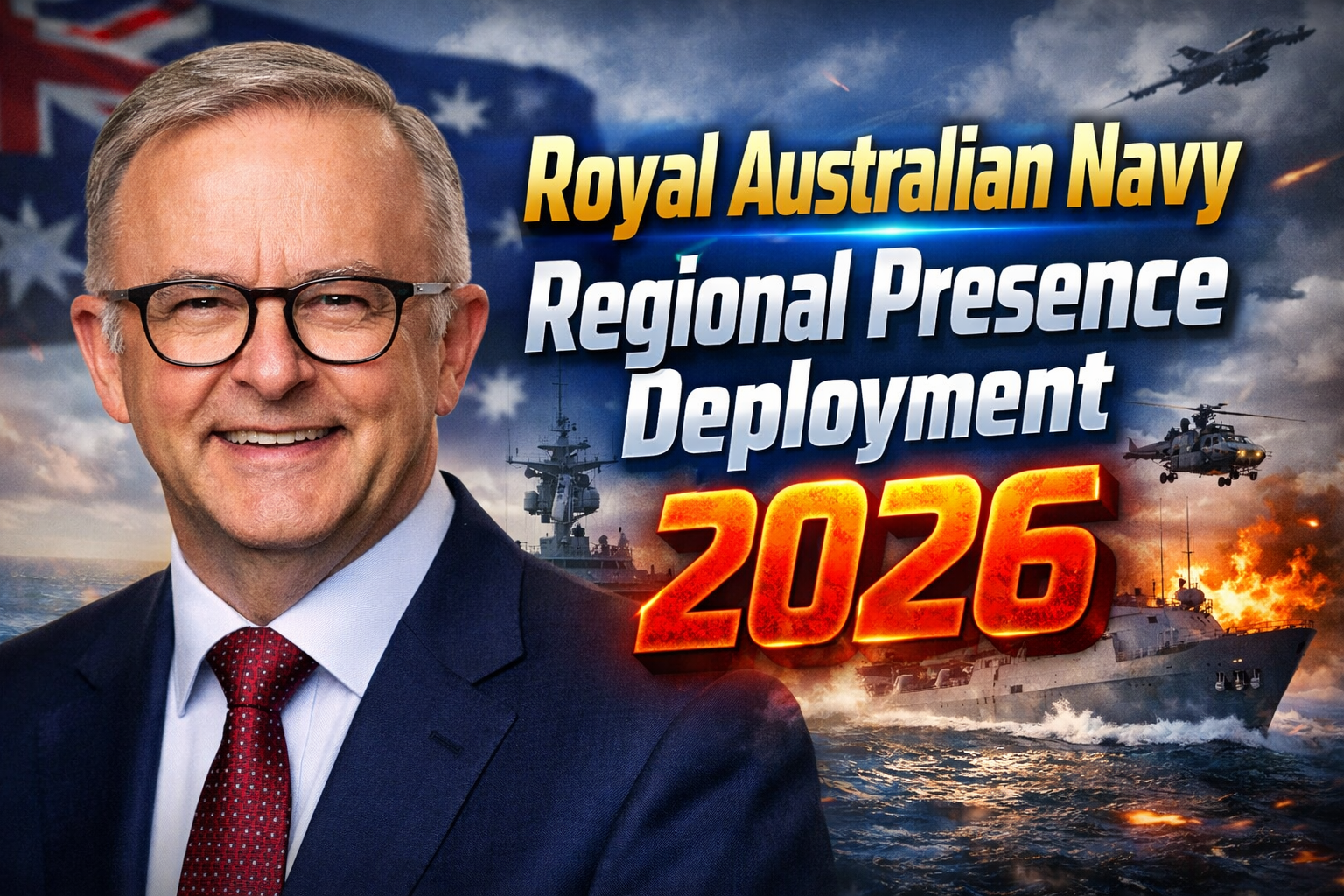
The Royal Australian Navy launched its first Regional Presence Deployments of 2026 with two Anzac-class frigates departing Fleet Base West, signaling Australia’s unwavering commitment to Indo-Pacific stability. These missions underscore a strategic pivot toward persistent maritime engagement amid rising regional tensions.
Deployment Overview
HMAS Warramunga and HMAS Toowoomba set sail in early February, marking the opening salvo of a year-long program blending exercises, port visits, and cooperative activities across South, Southeast, and East Asia. Warramunga heads for engagements with Thailand and India, fostering bilateral ties through joint drills and exchanges.
Toowoomba targets the South China Sea and East Asia, joining Philippine-hosted maritime activities alongside multinational partners. This follows late-2025 outings by HMAS Brisbane and Ballarat, maintaining near-continuous RAN presence.
Chief of Joint Operations Vice Admiral Justin Jones emphasized these operations as routine yet vital, building trust with neighbors while upholding a rules-based order. Crews, honed through rigorous training, embody Australia’s resolve in contested waters.
Strategic Foundations
Australia’s Indo-Pacific strategy hinges on forward presence to deter coercion, support allies, and secure trade lanes vital for economic prosperity. Regional Presence Deployments align with the Integrated Investment Program, prioritizing high-end warships for routine patrols over static basing.
The approach counters grey-zone tactics—militia incursions, island-building—through freedom-of-navigation signals without escalation. AUKUS Pillar One enhances subsurface reach, but surface fleets like Anzacs deliver visible reassurance.
Defence’s campaign plan integrates AI-driven analytics for real-time threat assessment, boosting decision cycles. Budget allocations sustain eight to ten major vessels forward-deployed annually, balancing capability with sustainability.
Key Missions and Activities
Deployments weave deterrence, diplomacy, and domain awareness.
- Maritime Cooperative Activities: Toowoomba joins Philippine Navy drills, rehearsing anti-submarine warfare, visit-board-search-seizure, and humanitarian scenarios.
- Bilateral Exercises: Warramunga drills with Royal Thai Navy on gunnery and replenishment-at-sea, then links with Indian Navy for anti-air tactics.
- Port Engagements: Stops in Jakarta, Mumbai, and Manila enable cultural exchanges, leader calls, and community outreach, humanizing Australia’s posture.
- Intelligence Sharing: Passive sonar and radar sweeps map baselines, feeding fusion centers for collective maritime picture.
These build interoperability, with standardized comms and tactics easing coalition responses.
Anzac-Class Capabilities
Mehr als two decades old, Anzacs remain backbone with upgrades restoring relevance.
| Feature | Specifications | Mission Role |
|---|---|---|
| Displacement | 3,600 tonnes | Versatile escort |
| Speed | 28 knots | Rapid response |
| Sensors | CEA Phased Array Radar | Air/surface track |
| Weapons | Harpoon missiles, 127mm gun, torpedoes | Multi-threat engagement |
| Helicopters | MH-60R Seahawk | ASW, surveillance |
| Crew | 160 personnel | Sustained ops |
Anti-Ship Missile Defence upgrades add SM-2 interceptors by mid-decade, while CEAFAR radar nets over-the-horizon detection. Fuel-efficient diesels enable 45-day transits without replenishment.
Indo-Pacific Geopolitical Context
Tensions simmer from South China Sea disputes to Taiwan Strait transits, with militia swarms testing resolve. Australia’s deployments signal alignment with Quad partners—US, Japan, India—without formal alliance expansion.
Philippine cooperation counters Salami-slicing, post-2016 arbitral loss. Indian ties deepen via Malabar expansions, hedging Himalayan frictions. Southeast Asian neutrality demands deft diplomacy, prioritizing ASEAN centrality.
Economic stakes loom: 60 percent of global trade traverses these seas, including Australia’s iron ore and LNG exports.
Impact on Regional Partners
Deployments amplify allies’ capacities without overstretch.
- Philippines: Bolsters EEZ patrols amid Scarborough Shoal pressures, sharing UAV feeds and training.
- Thailand/India: Enhances blue-water skills, with cross-deck landings fostering people-to-people bonds.
- Indonesia: Tanjung Priok visits reinforce Lombok Strait understandings, key chokepoint.
Multilateral forums like Indo-Pacific Endeavour layer effects, with 2025’s iteration drawing 20 nations.
Operational Challenges
Endurance tests crews: monsoons, mechanical gremlins, and isolation strain morale. Hybrid threats—cyber probes, drone swarms—demand vigilant EW suites.
Logistics lean on Singapore’s Changi hub and US prepositioning. Crew welfare pivots to mental health embeds and family connectivity.
Sustainability queries arise: Anzac mid-life refits compete with Hunter-class influx, risking gaps.
Broader RAN Transformation
Deployments preview Hunter frigates—Tier 1/2 lethality by 2030s—boasting hypersonics, directed energy. AUKUS SSNs add stealth punch from 2040s.
Surface fleet grows to 12 general-purpose frigates, six large optionally-crewed vessels. P-8A Poseidon fleets sustain ISR backbone.
Investments hit 50 billion for shipbuilding renaissance, anchoring northern yards.
Economic and Domestic Benefits
Deployments ripple domestically: 5,000 jobs sustained in Henderson, with spillovers to steel, sensors. Port economies gain from crew spending.
Industry gains export leads—Saab radars to Thailand, CEA tech regionally. STEM pipelines fill from sea cadet intakes.
Alliances and Multilateralism
Quadrilateral Security Dialogue evolves with Malabar 2026 eyed off Guam. Five Eyes maritime fusion counters sub-surface opacity.
Japan’s Izumo conversions sync ASW drills. France’s Suffren SSNs join Talisman Sabre rotations.
Future Trajectory
2026 promises intensified tempo: Arafura-class offshore patrols slotting in, Virginia-class visits. Hunter lead ship trials coincide mid-year.
Strategy eyes Distributed Lethality—smaller killers networking under CEC. AI autonomy trials on wingmen drones.
Risks and Mitigation
Escalation risks hover: inadvertent clashes demand ROE discipline. China’s carrier groups probe reactions.
Mitigation fuses diplomacy—hotlines, Track 1.5s—with readiness: live-fire qualifiers pre-sail.
Global Implications
Australia’s persistence reassures swing states, diluting coercion efficacy. It models middle-power agency, inspiring Vietnam, Malaysia emulations.
Indo-Pacific stability hinges on such routines, forestalling domain denial.
Community and Veteran Perspectives
Families steel for absences, buoyed by ADF support nets. Veterans hail continuity from East Timor to now.
Public discourse frames deployments as insurance premiums on prosperity.
RAN’s 2026 forays cement Australia’s maritime credentials—strategic, steady, southward anchor in turbulent seas.

Lance Evans is a contributor at CSKHYBER.co.nz covering New Zealand and Australia news, with a focus on trending updates and public-interest stories.