
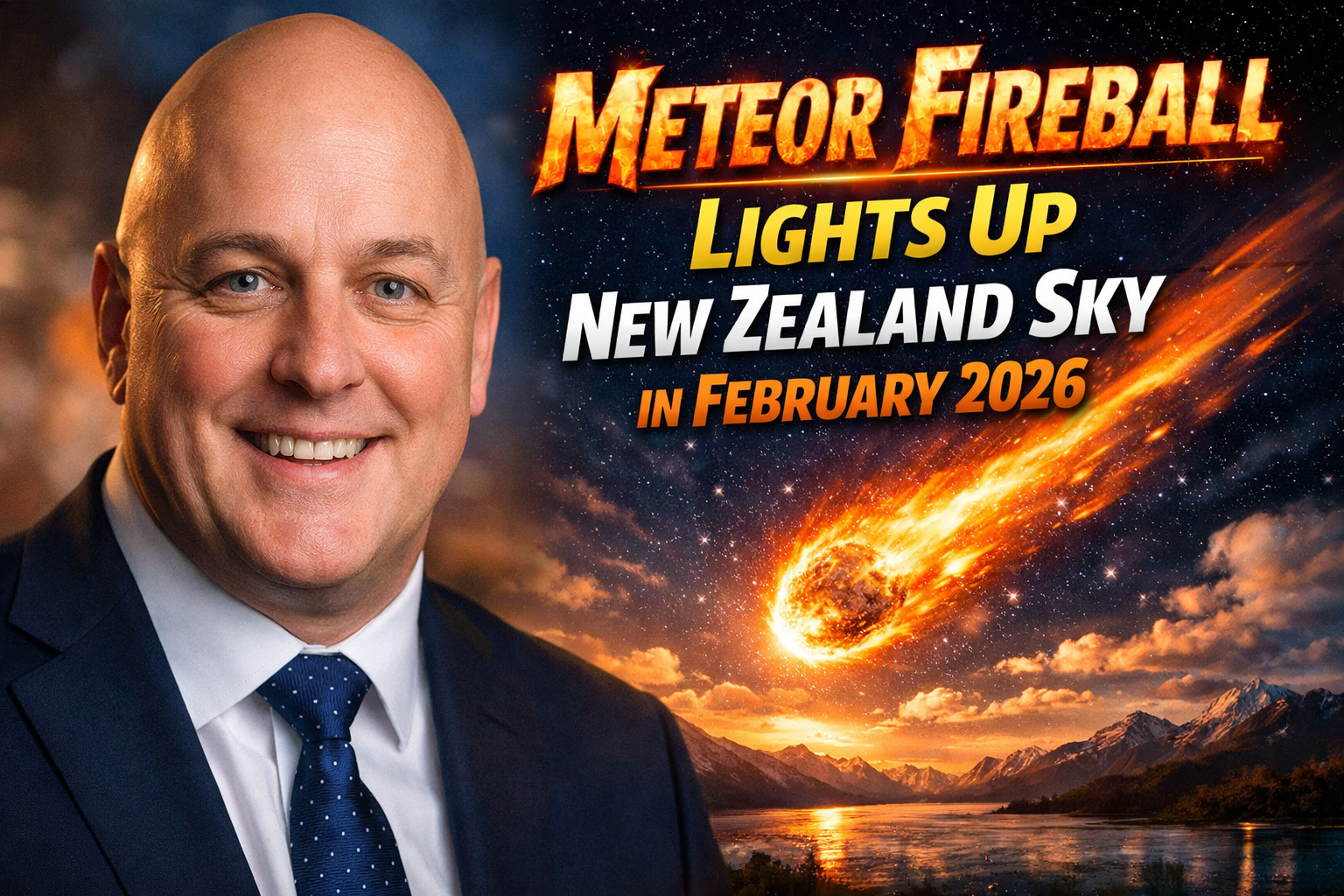
A brilliant green fireball streaked across New Zealand’s North Island sky in the early hours of February 5, 2026, turning night into day for thousands of startled residents. Visible just after 1:00 a.m., the cosmic visitor blazed from north to south, splitting into fragments before vanishing in a flash. Witnesses described an unforgettable spectacle, sparking frenzy on social media and drawing expert confirmation as one of the largest recent bolides over Aotearoa.
Event Timeline
The fireball appeared around 1:08-1:10 a.m. local time, first spotted over Northland’s west coast. It traced a shallow path southeastward, lighting up skies from Whangarei through Auckland, Tauranga, and down to Wellington. Duration lasted several seconds, with a prolonged green glow followed by breakup into three or four pieces trailing fiery tails.
Observers noted a massive sky flash at fragmentation, illuminating clouds and homes like daytime. No sonic boom reports surfaced, suggesting high-altitude disintegration around 30-50 kilometers up. Conditions—clear skies post-recent storms—ensured wide visibility across the North Island.
Witness Accounts
In Whangarei, Remon captured a vivid green streak plummeting at 1:08 a.m., posting video of the object slicing the horizon. Tauranga resident Shane described it splitting into glowing fragments with long tails, ending in a green sky flash on a crystal-clear night. Rural Whangarei farmer Anneka swore it “landed” on her property, prompting a dawn search amid shaken nerves.
Kaitaia locals shared early-morning clips of a bright flash, while Aucklanders awoke to blinding light piercing curtains. Lower Hutt videos echoed a prior Wellington event, with families rousing children to witness the eerie glow. Posts flooded platforms: “Sky exploded green!” and “Thought it was aliens or war.”
Scientific Explanation
This bolide—a super-bright meteor—formed when a grapefruit-sized space rock slammed into the atmosphere at tens of thousands of kilometers per hour. Friction superheated it to thousands of degrees, vaporizing material and creating the plasma trail. Green hue stemmed from magnesium or nickel ions emitting light at those temperatures, a hallmark of chondritic meteoroids from the asteroid belt.
Unlike faint shooting stars, bolides exceed minus-four magnitude, visible daytime. Breakup indicated a fragile composition, likely carbonaceous chondrite, scattering pea-sized fragments. Speed and angle prevented ground reach for most pieces, though dark flight models predict tiny survivors.
| Feature | Description | Typical Cause |
|---|---|---|
| Green Color | Vivid emerald trail | Magnesium/nickel burn |
| Fragmentation | Split into 3-4 pieces | Internal weaknesses |
| Brightness | Day-like illumination | Size over 1 meter |
| Duration | 4-7 seconds | Shallow entry angle |
This table breaks down the fireball’s standout traits.
Regional Impacts
Northland bore the brunt—exceptionally large per astronomers, breaking up offshore west coast. Tauranga reports peaked at 1:10 a.m., with tails visible longest there. Auckland streets lit momentarily, rousing urban sleepers; Manawatū-Whanganui tied to earlier sightings, hinting multiple events.
Wellington’s Lower Hutt mirrored a January 30 green fireball, suggesting swarm activity. South Island missed it entirely, blocked by horizon. No damage or injuries, but pets barked wildly, and drivers swerved from glare.
Expert Analysis
Te Whatu Stardome’s Josh Aoraki fielded dozens of calls, confirming a fireball akin to Wellington’s prior week—slower, brighter, green-tinged. University of Auckland’s Richard Easther deemed it natural, not debris, with bolide traits matching wide visibility. Fireballs NZ triangulated paths from eyewitness data, plotting strewn fields off Northland.
Size estimates hit one meter diameter, mass tens of kilograms—rare for New Zealand. No orbit ties to known showers like Geminids, pointing sporadic meteoroid. Astronomers urged fragment hunts in predicted zones.
Historical Context
New Zealand boasts a rich meteor legacy: the 2024 Tekapo fall yielded an 810-gram specimen minutes post-fireball. Green Lake’s 1908 iron meteorite scarred Canterbury plains. Recent barrages—multiple 2026 North Island events—align with asteroid belt dust peaks.
Global parallels include Australia’s February 3 fireballs, possibly linked southern hemisphere surge. Past bolides like Peak Hill (1960) left craters; most fizzle harmlessly, enriching lore.
| Past NZ Event | Date | Outcome |
|---|---|---|
| Tekapo Fall | March 2024 | Meteorite recovered |
| Green Lake | 1908 | Crater and irons |
| South Island Bolide | 2024 | 810g specimen |
Comparable incidents underscore frequency.
Potential Meteorite Fall
Dark flight—post-glow parabola—targets Northland fields and Whangarei farms. Fragile breakup favors dust over fist-sized rocks, but Anneka’s “landing” fuels hopes. Fireballs NZ mapped zones; public searches planned with metal detectors.
Fusion crust—blackened, thumbprinted shells—marks survivors. Rain-free weather aids recovery; finds aid composition studies, revealing solar system origins.
Public Reaction
Social media erupted: WeatherWatch logged hundreds of eyewitnesses, from stunned farmers to giddy kids. Videos amassed millions of views, memes dubbing it “alien invasion” or “Aotearoa fireworks.” Safety queries arose—no danger, as 99.9 percent burn up.
Skywatching apps spiked; Stardome hosted Q&As. Media frenzy boosted astronomy interest, with calls for national reporting networks.
Broader Significance
Fireballs offer free cosmic windows: spectra reveal asteroid ages, orbits trace belts. Climate ties emerge—clear post-storm skies amplified views. They remind urbanites of overhead wonders, spurring dark-sky advocacy.
Rare survivors advance science; this event joins global databases, refining impact risks. For Kiwis, it weaves into cultural tapestry—tāngata whenua tales of star falls echo modern awe.
New Zealand’s February skies delivered theater, blending science and wonder. Witnesses cherish the fleeting gift, eyes now heavenward for encores.

Lance Evans is a contributor at CSKHYBER.co.nz covering New Zealand and Australia news, with a focus on trending updates and public-interest stories.