
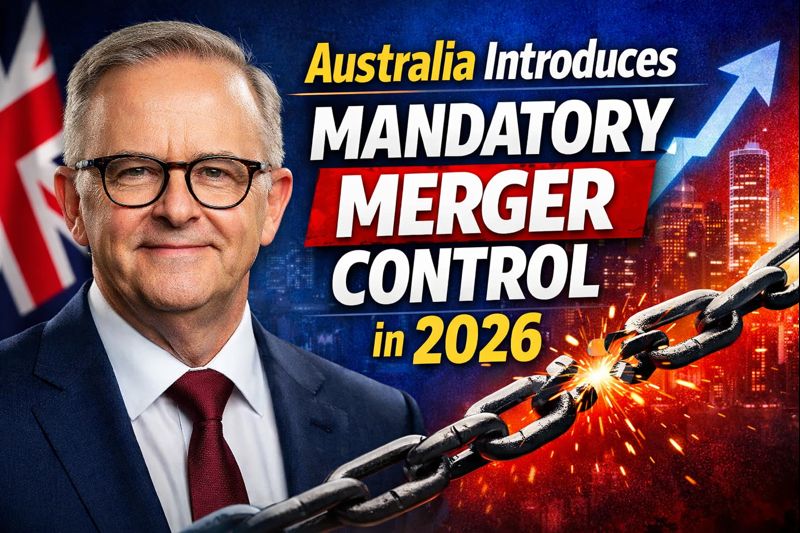
Australia’s merger control regime underwent its most transformative shift in decades starting January first, twenty twenty-six, mandating notifications to the Australian Competition and Consumer Commission for qualifying deals. This voluntary-to-mandatory change addresses creeping market consolidations that previously evaded scrutiny, aiming to safeguard competition in key sectors. Businesses now navigate suspensory rules, filing fees, and streamlined ACCC reviews, reshaping deal timelines and strategies.
Historical Context of Reforms
Australia long relied on a voluntary, non-suspensory system where firms self-assessed merger impacts under the Competition and Consumer Act, with ACCC intervention only post-completion if harm appeared. High-profile cases like supermarkets and digital platforms exposed gaps, prompting government reviews from twenty twenty-two onward. The Treasury Laws Amendment Act, passed late twenty twenty-four, enshrined mandatory notification to align with global standards like the European Union and United States.
Transitional voluntary filings began mid-twenty twenty-five, allowing early adaptation. By year-end, the regime locked in, prohibiting closings without clearance. This overhaul responds to serial acquisitions—smaller deals cumulatively reducing rivalry—and creeping shares in concentrated markets.
Critics once argued mandatory rules burdened small transactions, but proponents highlighted enforcement wins outweighing costs.
Key Features of the New Regime
Mandatory notification applies to acquisitions granting control, such as twenty percent voting power stakes, where targets conduct business in Australia. Suspensory mechanics halt closings until ACCC approval, with breaches risking voiding, fines up to ten percent global turnover, or divestitures. ACCC holds sole first-instance authority, assessing substantial lessening of competition or public benefits.
Public registers detail filings, boosting transparency. Timelines mandate informal pre-assessments, formal reviews within thirty working days for Phase I, and ninety for Phase II if needed. Fees scale by deal size: minimal for low-value, up to five hundred thousand dollars for mega-mergers.
Waivers permit non-notification in exceptional cases, like overriding public interest, decided by the Australian Competition Tribunal on ACCC recommendation.
Notification Thresholds Explained
Deals trigger review via three cumulative tests. First, global turnover surpasses five hundred million dollars, with Australian elements like fifty million local turnover or twenty percent share. Second, transaction value exceeds thresholds tied to Australian revenue: minimal for under one hundred million, escalating. Third, control acquisition in concentrated markets, targeting serial buyers gaining influence without dominance.
Safe harbors exempt low-risk vertical or conglomerate mergers below certain shares. ACCC guidance clarifies “carries on business,” capturing even nascent Australian footprints.
Businesses model scenarios early, as thresholds ensnare conglomerate risks previously overlooked.
| Threshold Type | Criteria | Example Impact |
|---|---|---|
| Turnover-Based | Global $500M+ with AU links | Cross-border M&A |
| Value-Based | Scaled by AU revenue | Private equity buyouts |
| Control-Based | 20%+ voting in target | Serial acquisitions |
| Concentration | High HHI increase | Sector consolidators |
ACCC Review Process
Parties submit detailed filings post-signed agreements, including competitive overlaps, efficiencies, and barriers. ACCC conducts market studies, stakeholder consultations, and economic modeling within tight deadlines. Phase I grants conditional clearances for clear passes; Phase II probes deeper with hearings.
Authorizations consider net public benefits overriding competition harms, rare but viable for efficiencies. Judicial review lies with the Federal Court, streamlining past delays.
Pre-merger consultations encourage early ACCC dialogue, reducing surprises.
Waivers and Exemptions
Notification waivers arise sparingly, granted by ACCC for minimal competition risk or urgent public needs, like national security. Applicants demonstrate no substantial lessening, often via undertakings. Tribunal appeals ensure checks.
De minimis exemptions shield micro-deals under value floors, easing small firm burdens. Gun-jumping penalties deter premature integration, with ACCC prioritizing education initially.
Waivers demand compelling evidence, rarely approved without ironclad cases.
Implications for Businesses
Deal timelines extend three to six months, prompting front-loaded due diligence. Private equity recalibrates serial strategies, while listed firms flag filings in ASX announcements. Cross-border players integrate Australian holds into global sequences.
Advisors stress scenario planning, with premiums for clearance expertise. Sectors like supermarkets, digital ads, and pharma face heightened scrutiny amid consolidation worries.
Costs rise via fees and delays, but certainty reduces post-close unwinds.
Sector-Specific Impacts
Supermarkets exemplify risks: incremental store grabs now aggregate scrutiny. Digital platforms notify algorithm-driven acquisitions, curbing data monopolies. Healthcare mergers weigh patient access against efficiencies.
Agribusiness notifications target input consolidations affecting farmers. Tech startups benefit from clarified safe harbors, fostering innovation without fear.
ACCC prioritizes high-impact sectors via guidance.
| Sector | Key Concerns | Reform Effect |
|---|---|---|
| Retail | Serial acquisitions | Cumulative review |
| Digital | Data control | Lower thresholds |
| Healthcare | Service access | Benefit weigh-ins |
| Agribusiness | Supply chains | Vertical scrutiny |
Compliance and Penalties
Gun-jumping—closing pre-clearance—invites injunctions, divestitures, or pecuniary penalties. ACCC monitors public announcements, ramping surveillance. Self-reporting mitigates fines, with cooperation credits.
Directors face personal liability for aiding breaches. Record-keeping mandates persist five years post-close.
Compliance programs embed merger modules, training deal teams.
Global Alignment and Divergences
Australia mirrors EU suspensory holds but diverges via single-agency first review, skipping phased filings elsewhere. US Hart-Scott-Rodino parallels emerge, though ACCC emphasizes substantive tests over formalities.
China’s SAMR coordination looms for overlapping probes. ASEAN neighbors watch, potentially harmonizing.
Dealmakers juggle multi-jurisdictional timing.
Transition Challenges
Twenty twenty-five deals straddle regimes: pre-July voluntary, post-January mandatory. Uncompleted transactions refile if thresholds hit. ACCC backlog risks delays, urging early voluntary submissions.
Stakeholders adapt contracts with clearance conditions, MAC clauses tweaking for reviews.
Economic Rationale
Reforms counter “killer acquisitions” stifling startups and monopsony power squeezing suppliers. Productivity gains from vigorous competition justify burdens, per Treasury modeling. Public benefits test accommodates welfare-enhancing mergers.
Critics eye overreach chilling deals, but pilots suggest measured enforcement.
ACCC Enforcement Priorities
Chair Gina Cass-Gottlieb signals focus on digital, essential services, and incrementalism. Merger intelligence units trawl data for unreported risks. Public tips and sector sweeps bolster oversight.
Guidelines evolve via consultations, refining tests.
Judicial Oversight Role
Federal Court reviews ACCC errors of law or fact, with merits appeals possible. Tribunal handles authorizations and waivers, ensuring procedural fairness.
Precedents shape substantive thresholds.
Practical Deal Strategies
Buyers sequence filings early, pairing with antitrust counsel. Sellers covenant notifications, sharing fees. Contingent value rights bridge clearance uncertainties.
Post-clearance integration plans await green lights.
Future Evolution
ACCC commits annual reviews, tweaking thresholds inflation-linked. Digital markets acts complement, targeting platform power.
Stakeholder feedback shapes refinements.
Stakeholder Perspectives
Business councils applaud clarity, urging light-touch for small deals. Consumer groups cheer protections, eyeing enforcement budgets. Unions highlight job safeguards.
Reforms balance growth with rivalry.
International Comparisons
EU’s one-phase rigor contrasts Australia’s tiers. UK’s dual-regime hybrid informs. Canada’s bureau-led model aligns closely.
Australia carves a streamlined path.
| Jurisdiction | Mandatory? | Suspensory? | Agency |
|---|---|---|---|
| Australia (New) | Yes | Yes | ACCC Sole |
| EU | Yes | Yes | Multi-Phased |
| US | Yes | Yes | FTC/DOJ |
| UK | Partial | No | CMA |
Long-Term Outlook
Mandatory control fortifies markets, deterring anticompetitive tides. Innovation thrives under fair play, with ACCC as trusted referee. Businesses adapt, embedding compliance as routine.

Lance Evans is a contributor at CSKHYBER.co.nz covering New Zealand and Australia news, with a focus on trending updates and public-interest stories.